






Nearly five decades after its release, John Carpenter’s masterpiece hasn't aged a day. Its singular power comes not from gore, but from a relentless, minimalist craft that turns one suburban evening into a seamless, suffocating nightmare.
The Sound of Inevitability
The first notes
of John Carpenter’s main theme are instantly recognizable: a simple, skeletal piano melody played over a pulsing synthesizer. But its genius lies in its rhythm. Composed in a rare 5/4 time signature, the music feels perpetually off-kilter and unnerving. Carpenter has said the rhythm was something his father taught him on a pair of bongos as a child. That unusual timing creates a propulsive, looping dread that never resolves, making the score feel less like music and more like a countdown to something terrible. It’s cold, mechanical, and repetitive, mirroring the emotionless persistence of its villain. Made on a shoestring budget in just a few days, the score proves that terror doesn't require a booming orchestra—just a few perfectly chosen notes that get under your skin and stay there.
The Stalker’s Eye
Long before found footage became a horror staple, 'Halloween' put the audience directly behind the killer’s eyes. The legendary opening sequence is a long, unbroken point-of-view shot from the perspective of a six-year-old Michael Myers. This was achieved by cinematographer Dean Cundey using a Panaglide, a competitor to the then-new Steadicam, which allows the camera to glide with an eerie, supernatural smoothness. It feels like a presence, not a person holding a camera. This technique does more than just establish the killer; it makes the viewer complicit. Throughout the film, Carpenter and Cundey use the wide Panavision frame to masterful effect, often placing Michael at the edge of the shot, barely visible behind a hedge or across the street. You start scanning every shadow, turning the placid suburban landscape into a hunting ground where evil could be lurking anywhere.
The Threat in Your Own Backyard
Horror was often set in gothic castles or isolated, rural locations. 'Halloween' brought terror home. The fictional Haddonfield, Illinois, is the quintessential American suburb—a place of unlocked doors, quiet streets, and kids walking home from school. By setting the story in a place so deliberately mundane and familiar, the film taps into a primal fear: the invasion of a safe space. The horror isn't just that a killer is on the loose, but that he's walking down your sidewalk. The film brilliantly weaponizes the illusion of suburban safety, showing how quickly it can crumble. In one of the film's most chilling sequences, a terrified Laurie Strode bangs on a neighbor's door, screaming for help, only to see the porch light turned off. The very structure of the neighborhood, with its isolated homes, becomes a trap.
The Shape with No Motive
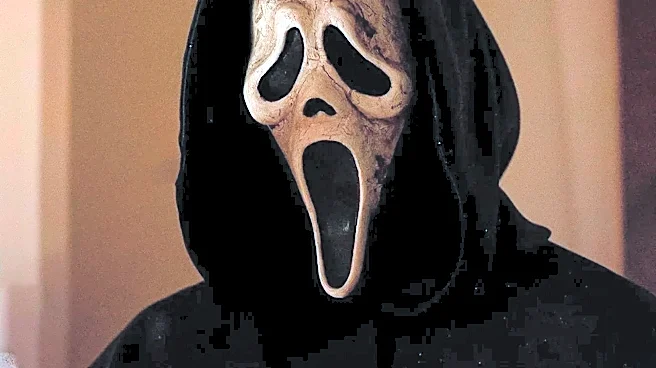
Later slasher franchises would give their villains elaborate backstories and motivations, but the original Michael Myers is terrifying because he has none. He is credited only as 'The Shape,' a silent, relentless force of nature. There is no complex psychology to analyze and no tragic past to explain his actions. As his psychiatrist, Dr. Loomis, explains, he is purely and simply 'evil.' This lack of explanation makes him something more than a man; he becomes an unknowable entity, a human embodiment of senseless violence. He never runs, he never speaks, and his blank, white mask reveals nothing. This emptiness is what makes him so enduringly frightening. You can’t reason with him or understand him. You can only run.