



The Perfect Black Canvas
The experience begins with the environment itself. The Black Rock Desert, known to attendees as “the playa,” is almost perfectly suited to disorient the human brain. It's an ancient lakebed, exceptionally flat, vast, and devoid of trees, buildings, or landmarks.
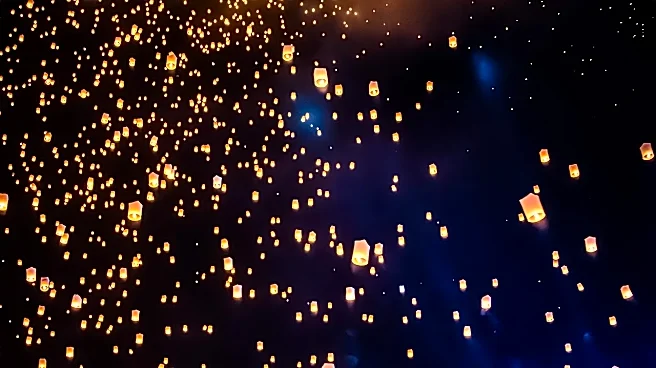
At night, with minimal light pollution from distant towns, the darkness is profound and complete. This creates a sensory blank slate. Our brains constantly use background cues—the line of a street, the silhouette of a hill, the texture of a wall—to judge distance, scale, and motion. On the playa, these references are gone. An object pulsating with light a thousand feet away can feel as close as one fifty feet away. This lack of depth perception is the first step in unmooring you from reality. The sheer, empty darkness becomes a perfect canvas for the art to come.
Your Eyes on the Playa
Next, consider the biology of your own eyes. Your retina contains two types of photoreceptor cells: cones and rods. Cones are clustered in the center of your vision and detect color and fine detail, but they require bright light to work properly. Rods, which dominate your peripheral vision, are far more sensitive in low light but see only in black and white and are specialized for detecting motion. Out on the playa, this creates a strange dual reality. When you look directly at a colossal, LED-covered art car, your cones are saturated with intensely vivid color. But in the vast, darker spaces between the art, and at the edges of your vision, it's your rods that do the heavy lifting. This is why you perceive ghostly, monochrome movement in your periphery while the scene directly in front of you is a blaze of color. This disconnect between your central and peripheral vision is inherently unsettling and dreamlike.
The Nature of the Light
The art itself is the third crucial ingredient. Burning Man’s light art isn’t just a string of Christmas lights; it’s often massive, kinetic, and programmed with complex patterns. You might see a 40-foot-tall metal sculpture breathing plumes of fire or a bicycle parade with every spoke wrapped in synchronized LEDs, creating shifting patterns that float through the dark. This isn't passive viewing. The sheer scale and movement can induce sensory overload. Furthermore, the ever-present playa dust in the air catches and scatters the light. This atmospheric effect softens sharp edges and creates halos, or auras, around distant light sources, making them appear to hover and bloom in the darkness. The light isn't just on an object; it becomes an ethereal object in itself, further confusing your brain's attempts to interpret the scene.
How Your Brain Fills the Gaps
The final piece of the puzzle is your brain’s desperate attempt to make sense of it all. Faced with a lack of reference points, conflicting information from your rods and cones, and overwhelming sensory input, your brain’s visual cortex has to start making educated guesses. This process is known as “perceptual completion” or, more colloquially, “filling in the gaps.” Your brain builds a version of reality based on incomplete and contradictory data. It might misinterpret the scale of a faraway art piece, perceive movement where there is none, or blend the memory of one dazzling light display with another. It is this active, imaginative process of constructing a world—not just observing one—that produces the profound feeling of surrealism. You're not just seeing a light show; you are co-creating a dreamscape inside your own head. The art, the desert, and your own biology conspire to make it happen.