
1. It’s Not Always Just Tulle
When you see a frothy, cloud-like gown, you're likely looking at a complex blend of fabrics. Designers layer different materials to achieve the perfect volume and movement. Tulle is often the star, but
it’s supported by a cast of silk organza, crinoline, and horsehair braid to give the garment structure and prevent it from collapsing.
2. The 'Tulle Capital' of France
Many of the world's most prestigious couture houses, like Dior and Chanel, source their high-end tulle from family-owned mills in Northern France, particularly around the city of Caudry. This region has been the global epicenter of lace and tulle production for centuries, and its craftsmanship is considered unparalleled.
3. A Single Gown Uses Hundreds of Meters
That voluminous look doesn't come cheap, in fabric or in quantity. A significant red-carpet tulle gown, like those favored by Dior, can require anywhere from 100 to 400 meters of fabric. The material is gathered, pleated, and layered meticulously by hand to create the final jaw-dropping silhouette.
4. The Color is a Closely Guarded Secret
The exact shade of a gown is a crucial part of its magic. Tulle is often custom-dyed in a process that can take weeks to perfect. The goal is to find a color that not only complements the celebrity's skin tone but also pops perfectly under the harsh flashes of the red-carpet photographers.
5. 'Point d'Esprit' is the Holy Grail
Not all tulle is created equal. The most sought-after variety for couture is often 'point d'esprit,' a type of dotted netting that adds subtle texture and depth. Another prized version is silk tulle, which is significantly softer, more delicate, and drapes more beautifully than its nylon counterpart, but is also far more expensive and difficult to work with.
6. Couture Teams Book 'Tulle Specialists'
Working with hundreds of meters of delicate tulle is a specialized skill. Haute couture ateliers employ 'petites mains' (literally, 'little hands') who are masters of handling this specific fabric. Their jobs are dedicated to gathering, pleating, and embroidering tulle, a task that requires immense patience and precision.
7. Weather Is Tulle's Greatest Enemy
The famous Cannes sea breeze and the potential for a sudden Riviera rain shower are a tulle gown’s worst nightmare. The delicate fabric can easily snag, tear, or become waterlogged, losing its shape instantly. Teams are always on standby with hairdryers and emergency tools for last-minute fixes.
8. The 'Scrunch Test' Is Real
Before a gown is even finished, stylists and designers perform a 'scrunch test.' They will literally bunch up the fabric in their hands and see how it behaves when it's sat on, walked in, and subjected to movement. It has to look as good getting out of the car as it does standing on the steps.
9. Every Gown Has a Secret Repair Kit
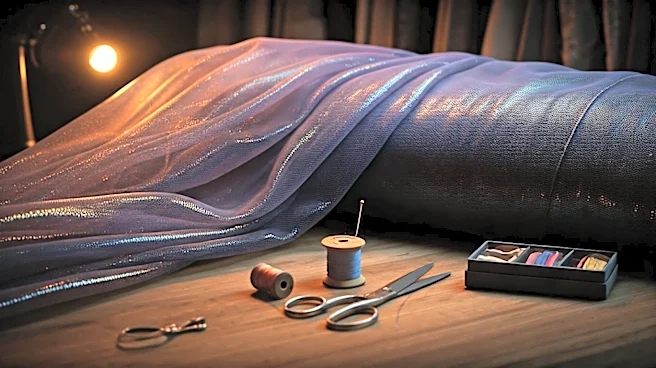
A stylist accompanying a star with a major tulle gown will have an emergency kit. It typically includes a small needle with invisible thread, tiny scissors, and, most importantly, static guard. Static cling can cause layers of tulle to stick together, ruining the intended silhouette.
10. The Journey to Cannes Is First-Class
These gowns don't just get packed into a suitcase. A massive tulle creation often travels in a custom-built crate or travels with a dedicated handler on a plane, sometimes even occupying its own seat. The goal is to minimize folding and crushing at all costs.
11. Lighting Directors Have a Love-Hate Relationship
The sheer, layered nature of tulle can create a beautiful moiré effect under television lights, which can be mesmerizing. However, it can also be transparent in unexpected ways under the relentless flashbulbs of the paparazzi, making careful undergarment strategy an absolute necessity.
12. Embroidery Can Take Thousands of Hours
When tulle is embroidered with beads, sequins, or crystals, the labor involved is astronomical. For a major couture piece, a team of artisans at a workshop like Lesage in Paris might spend over 1,000 hours hand-sewing embellishments onto the delicate netting before it's even constructed into a gown.
13. It's Often a One-Night-Only Affair
Due to its fragility, a tulle gown worn on the Cannes red carpet is often too damaged for a second outing. The hem gets shredded from walking, it gets snagged by jewelry, and it can be stained by makeup or champagne. Its moment of glory is beautiful but brief.
14. The 'Illusion' Neckline Depends On It
That 'strapless' dress with intricate beading seemingly floating on the skin? That's thanks to illusion tulle. It's an ultra-fine, flesh-toned netting that is strong enough to hold thousands of crystals while being virtually invisible to the camera, giving the magical effect of floating embroidery.
15. Post-Cannes, They're Often Archived or Deconstructed
After their red carpet debut, these gowns are carefully cleaned and either returned to the fashion house's archives to be preserved as a piece of brand history, or in some cases, deconstructed. The valuable embroidery might be salvaged for a future creation, giving the intricate work a second life.