





The Paris-Dominated Fashion World
In the 1930s, American fashion had a distinct inferiority complex. The rule was simple: Paris dictated, and Seventh Avenue copied. For a manufacturer like Townley Frocks, success meant producing affordable replicas of French haute couture for the American market.
Originality was not just discouraged; it was seen as a commercial risk. Designers were sent to Paris to absorb the latest trends and bring them back to be duplicated. Into this environment stepped Claire McCardell, a young designer with a quiet but firm belief that clothes should serve the women wearing them, not the other way around. She found the rigid, structured styles impractical for the modern woman's increasingly active life.
An Accidental Opportunity
McCardell began her time at Townley Frocks as an assistant to head designer Robert Turk. When Turk tragically drowned in 1932, McCardell was tasked with finishing his fall line. This promotion gave her a platform, but her ideas—like using casual fabrics such as denim and wool jersey, or adding functional pockets—were often seen as too radical by the company's owner, Henry Geiss. Her innovative designs were frequently pushed to the back of the showroom, overshadowed by the safer Parisian copies. McCardell, however, began wearing her own experimental designs to work, creating clothes for herself that she couldn't find anywhere else.
The 'Monastic' Dress and the Crisis
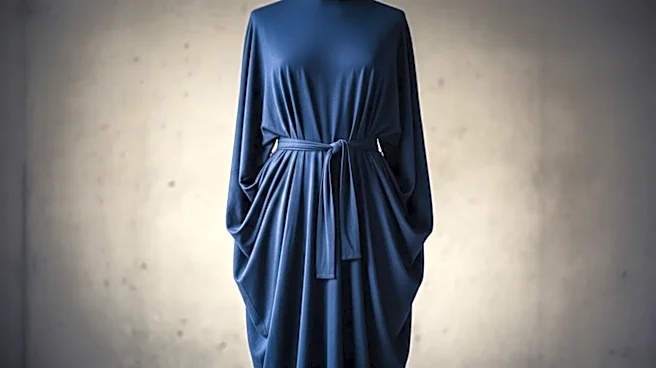
The collection in question was McCardell's vision made real, and it was a commercial failure at first glance. The centerpiece was a daringly simple design she called the "Monastic" dress. It was a bias-cut, tent-like garment with no darts, no defined waist, and no obvious structure. To the executives and buyers of the day, it had no "hanger appeal." It was so unstructured, in fact, that it was hard to tell the front from the back. The idea was that the wearer would use a simple spaghetti-tie belt to cinch the waist, creating her own flattering silhouette. But Townley's leadership balked, and the revolutionary collection was effectively shelved.
A Fortunate Encounter
The collection may have been dead on arrival, but McCardell continued to wear her personal version of the Monastic dress. Legend has it that a buyer from the department store Best & Co. was in the Townley showroom when he spotted McCardell in her dress and demanded to know why he hadn't seen that model. Intrigued by the design that was so unlike anything else on offer, he bypassed the main collection and placed an order for 100 units of the Monastic. Priced at under $30, the entire stock sold out in a single day.
The Birth of the 'American Look'
The Monastic's runaway success was a double-edged sword. Its popularity led to a flood of unauthorized copies, and the legal battles to fight the knock-offs were so costly that they ironically drove Townley Frocks out of business in 1938. McCardell briefly went to work for the more traditional designer Hattie Carnegie, where her practical style didn't fit in. But the seeds of a revolution had been planted. When Townley Frocks reopened in 1940 under new management, they brought McCardell back—this time on her own terms. A condition of her return was that her name would be on the label, making her one of the first American designers to become a brand in her own right. The near-failure and ultimate vindication of her first collection proved that American women were hungry for fashion that was accessible, comfortable, and empowering. It marked the true beginning of the "American Look" and cemented Claire McCardell's legacy as its foremost pioneer.