




1. Flip It Over
The fastest and most reliable test is to look at the back of the fabric. A genuinely woven pattern, like a jacquard, will show a 'negative' of the design on the reverse, often with inverse colors and visible threads called floats. An embroidered piece
will reveal the stitching that holds the design in place. A printed fabric, however, will usually have a plain, pale, or blank back, as the ink sits only on the surface. If the back tells no story, it's likely a print.
2. Feel for Texture and Dimension
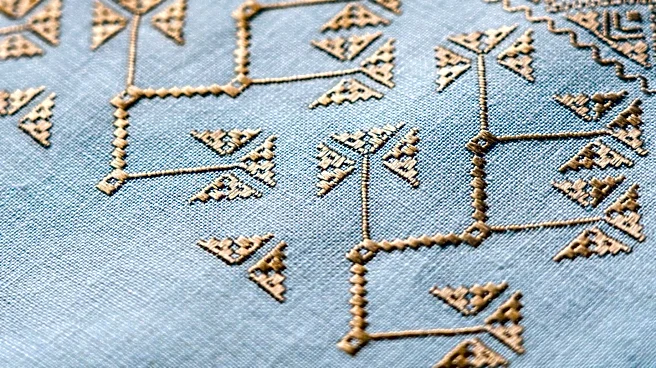
Run your fingers across the surface. True craft has a physical presence. Embroidery creates a distinctly raised, three-dimensional design you can feel. Woven patterns like jacquard or damask have a tactile quality, with the design feeling integrated into the fabric's structure. Even hand-block prints can leave a slightly raised texture where the block pressed dye into the fibers. A printed effect, by contrast, generally feels flat and smooth, with no change in texture where the 'pattern' appears.
3. Examine the Edges of the Pattern
Look closely at the outlines of the motifs. Handmade techniques leave distinct signatures. In authentic ikat, the edges of the pattern are characteristically soft or 'feathered' because the threads shift slightly during weaving. Hand-block prints often have a gentle bleed at the edges where the dye has soaked into the fibers. A printed pattern, especially a digital one, will have perfectly sharp, crisp, and uniform edges, much like an image from an inkjet printer.
4. Hunt for 'Perfect Imperfections'
In handcrafted textiles, slight irregularities are a sign of authenticity, not a flaw. When you compare two repeating motifs in a hand-block print, you'll notice small variations in alignment, color density, or pressure. A handwoven fabric might show subtle shifts in yarn tension. Machine-made prints strive for flawless uniformity; every repeat is identical. If a pattern seems too perfect, it probably is.
5. Analyze the Color Saturation
In a crafted textile, the color is part of the fabric's structure. In a woven jacquard, the color comes from the threads themselves. In a hand-block print, the dye soaks into the fibers, often resulting in slight variations in density where the block was re-inked. With printed fabric, the color is a uniform layer applied to the surface. This is why prints can fade, crack, or peel over time in a way that woven-in color will not.
6. Look for Loose Threads or Knots
This is especially useful for identifying embroidery or certain types of weaves. The reverse side of a hand-embroidered piece might have small knots or trailing threads where the artisan started or ended a color. While high-end pieces are often finished cleanly, some evidence of the handwork remains. Similarly, the back of a complex woven fabric may reveal floats—long threads that carry a color across the back until it's needed again on the front. A printed surface has none of these structural artifacts.
7. Inspect the Selvage
The selvage is the self-finished edge of a fabric that prevents it from unraveling. In handloom or shuttle-loom weaving, the selvages are often a bit rougher, tighter, or more uneven than the rest of the fabric because the same weft thread turns back on itself. Power looms, which are used for most mass-produced fabrics destined for printing, often produce a cleaner, more uniform edge, sometimes with tiny fringe-like threads or holes from the machine's grippers.
8. Consider the Price
While not a construction clue itself, price is a powerful indicator. Creating a pattern by weaving, embroidering, or hand-blocking requires immense skill and time—sometimes days or weeks for a single piece. Printing is a fast, mechanized process designed for volume and affordability. If you find a large, complex 'ikat' or 'embroidered' piece for a shockingly low price, your skepticism is probably warranted. True craftsmanship has a cost that reflects the labor and artistry involved.