


Quantum Entanglement
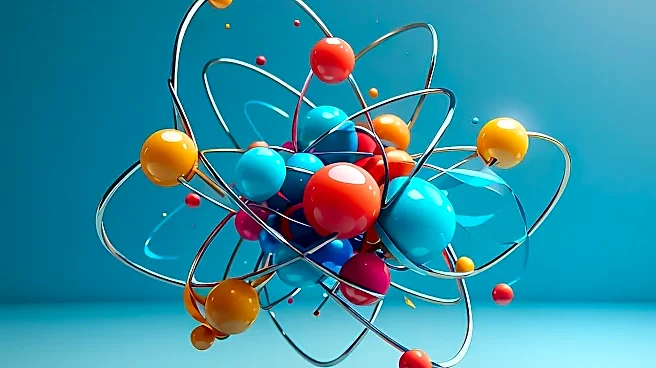
Often called “spooky action at a distance,” this is a real phenomenon where two particles become linked. No matter how far apart you pull them—even across the galaxy—what happens to one instantly affects the other. Think of them as a pair of cosmic dice
that always land on the same number. Movies use this as a basis for instant communication or teleportation. While it doesn't work for faster-than-light messaging in the real world (sorry, Starfleet), the connection is real and is the foundation for next-gen quantum computing and cryptography. So when a character in a film mentions entangled particles to explain a futuristic gadget, they’re tapping into one of the weirdest and most wonderful truths of our universe.
Black Hole and Event Horizon
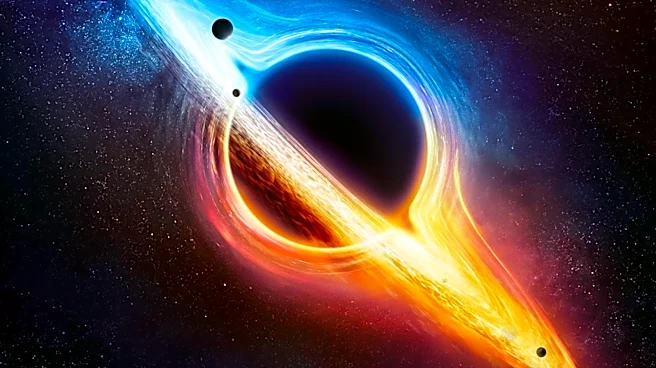
A black hole isn’t really a hole, but an object so dense that its gravity warps space and time around it. Nothing, not even light, can escape its pull once it crosses a certain boundary. That boundary is the event horizon. Think of it as the ultimate point of no return. In films like Interstellar, the event horizon is a dramatic threshold. Crossing it means entering a region where the laws of physics as we know them break down at the central point, called a singularity. While Hollywood often imagines brave explorers surviving the trip, in reality, the immense gravitational forces would stretch any object into a thin strand, a process cheekily nicknamed “spaghettification.”
Wormhole (or Einstein-Rosen Bridge)
How do spaceships hop across galaxies in a single afternoon? Often, the answer is a wormhole. First theorized by Albert Einstein and Nathan Rosen, a wormhole is a hypothetical tunnel through spacetime. Imagine spacetime is a giant sheet of paper. To get from one point to another, you could travel across the surface, or you could fold the paper and poke a hole through it, creating a massive shortcut. That's a wormhole. While mathematically possible according to the theory of general relativity, they remain purely theoretical. To be stable enough for a ship to pass through, scientists believe a wormhole would need to be propped open by something called “exotic matter,” which has properties unlike anything we've ever observed.
Artificial Intelligence (AI)
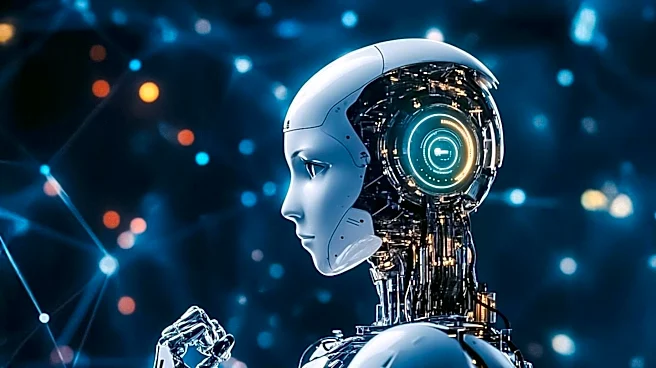
This one has moved from science fiction to daily headlines, but movies still love to explore its extremes. At its core, AI is about creating computer systems that can perform tasks requiring human intelligence, like learning and problem-solving. In entertainment, AI is often a character—either a helpful sidekick like Jarvis in the Iron Man films or a world-ending threat like Skynet from The Terminator. The most dramatic plot point is often the “singularity,” a hypothetical moment when AI surpasses human intelligence and begins to rapidly self-improve, leading to an unpredictable new reality. While we’re still far from sentient robot overlords, the questions these stories raise about consciousness, control, and what it means to be human are more relevant than ever.
Genetic Editing (CRISPR)
Whenever a movie character gets superpowers from a lab accident or a dinosaur is brought back to life, the science behind it is usually related to genetic editing. The modern-day version of this is CRISPR, a real-world technology that allows scientists to find and alter specific bits of DNA with incredible precision. While sci-fi uses it to create super-soldiers or cure every disease imaginable, real scientists are using it to research treatments for genetic disorders. The movies are right about one thing: the ethical questions are huge. The power to rewrite the code of life itself comes with a massive responsibility that society is only just beginning to grapple with.
Dyson Sphere
Ever wonder how a civilization could power an entire galactic empire? Enter the Dyson sphere. This is a hypothetical megastructure that an extremely advanced civilization would build to completely enclose a star and capture 100% of its energy output. First proposed by physicist Freeman Dyson, the idea wasn't a solid shell but more likely a “swarm” of countless orbiting solar collectors. When you see one in a game or a show like Star Trek, it's a visual shorthand for a civilization that is almost god-like in its technological prowess. It’s the ultimate renewable energy project, taking the concept of solar panels to a truly stellar scale.