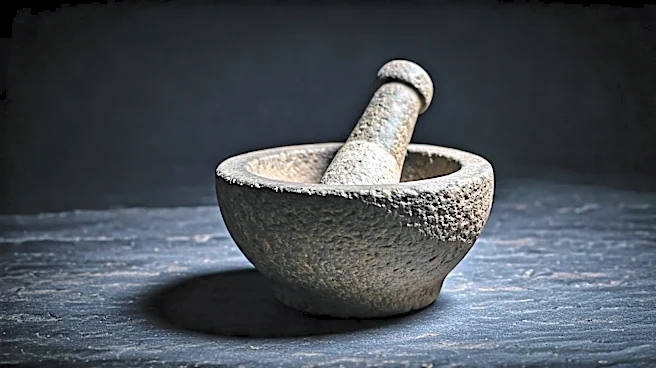








The Answer in Your Cabinet
So, what is it? The blender’s great-great-great (add about a thousand more ‘greats’) grandparent: the mortar and pestle. That simple bowl and club-like tool, used for grinding spices, herbs, and grains, is one of the oldest human inventions still in use today. While we often think of history in terms of empires and monuments, this humble object tells a much longer story about our daily survival and culture. It’s not just a kitchen gadget; it's an archaeological artifact that you can use to make pesto.
Putting “Ancient” in Perspective
Let's get the timeline straight, because it’s genuinely staggering. The Great Pyramid of Giza was completed around 2560 BCE, making it roughly 4,500 years old. That’s impressive. But the earliest known mortar and pestle sets? Archaeologists have
found examples dating back at least 35,000 years. That means humans were using a mortar and pestle for over 30,000 years *before* the first stone was laid at Giza. It predates the invention of agriculture, the wheel, and written language. When our ancestors were painting on cave walls in Europe, they were likely using a mortar and pestle to grind the pigments. It’s less of a kitchen tool and more of a cornerstone of human ingenuity.
Humanity's First Food Processor
Before farming took hold, hunter-gatherers relied on the mortar and pestle to make their environment edible. It was the original food processor, a critical piece of technology for survival. By using it to crush and grind, early humans could break down tough grains, nuts, and seeds that were otherwise indigestible. This unlocked vital new sources of calories and nutrients, giving us a major evolutionary advantage. The simple act of pounding wild wheat or cracking open nuts with a pestle fundamentally changed our relationship with food, turning inedible plants into sustenance. This process was the first step toward the breads, porridges, and flours that would later form the foundation of settled civilization.
More Than Just a Meal
The tool’s utility quickly expanded beyond the food supply. For millennia, it has been central to medicine and chemistry. The iconic bowl-and-club symbol of the apothecary (or modern pharmacy) is a direct depiction of the mortar and pestle, representing its essential role in compounding remedies by grinding medicinal herbs, minerals, and chemicals. Artists used it to crush minerals and plants into fine pigments for paint. It was used in spiritual ceremonies to prepare sacred plants and in early metallurgy to crush ore. Its form is so simple and its function so fundamental—to break something down into its constituent parts or blend things into a new whole—that it found a home in nearly every facet of human development.
The Modern Kitchen Comeback
In an age of whirring blades and high-speed blenders, the mortar and pestle could easily have become a museum piece. Yet, it’s experiencing a resurgence. Chefs and home cooks are rediscovering what ancient cultures always knew: grinding is not the same as chopping. An electric spice grinder or food processor uses blades to chop ingredients into tiny pieces. A mortar and pestle crushes them, rupturing cell walls and releasing essential oils and aromatic compounds in a way that blades can’t. It’s why pesto made in a mortar is more fragrant, why a spice blend is more pungent, and why guacamole is creamier. It requires a bit more effort, but the connection to the process and the superior flavor are rewards in themselves.