





First, What Exactly Is Sound Bleed?
Think of it like trying to have an intimate conversation at a crowded party. Even if you’re focused on one person, you can’t help but overhear the loud story being told three feet away. In the festival world, sound bleed is the unwanted audio from one stage
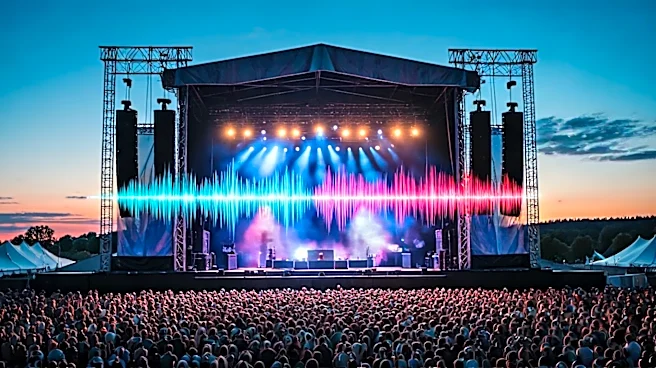
spilling over and polluting the sonic environment of another. It’s a battle of frequencies. The deep, low-end frequencies of an EDM set are notoriously difficult to contain; they travel for miles and can pass through objects, while the higher-end frequencies of a vocalist or a guitar solo are more directional and easier to absorb or block. When that deep ‘wub-wub’ from a DJ set half a mile away muddies the delicate fingerpicking of a folk artist you’ve waited all day to see, that’s sound bleed in action. It doesn’t just make things sound bad—it shatters the immersive experience that festivals sell.
Bonnaroo's Geographic Curse
Most festivals grapple with this, but Bonnaroo’s problem is baked into its very identity. The venue, affectionately known as “The Farm,” is a sprawling, 700-acre expanse of famously flat Tennessee farmland. While that open space is perfect for accommodating massive crowds and sprawling campgrounds, it’s an acoustic nightmare. There are no natural barriers like hills, valleys, or dense tree lines to absorb and break up sound waves. Sound just… travels. The primary stages are laid out in a vast, open field. In recent years, the proximity of the high-energy “Other Stage,” which runs late with electronic acts, to the more varied genres at the “Which Stage” and the main “What Stage” has become a recurring point of frustration for attendees. The result is a sonic soup where the climax of a headliner’s rock ballad might be unintentionally remixed by a dubstep drop from across Centeroo.
The Modern Sound Engineer's Toolkit
So how does a hypothetical 2026 design team tackle a problem rooted in geography? Fortunately, audio technology has come a long way. The first and most obvious solution is strategic stage placement and orientation. By simply angling stages away from each other, engineers can drastically reduce direct sonic interference. But the real magic is in the tech. Modern sound systems use ‘line arrays’—those curved columns of speakers you see hanging on either side of a stage. These are designed to focus sound downwards and outwards towards the audience in a controlled, narrow pattern, rather than blasting it in every direction. This precision minimizes spill. Another key tool is the delay tower. These are smaller speaker stacks placed partway back in the crowd. They ‘repeat’ the sound from the main stage, allowing the front-of-house engineer to run the main PA system at a lower overall volume. A quieter main system means less sound traveling beyond the intended audience area.
Predicting the Noise with Software
Perhaps the most powerful weapon in the fight against sound bleed is computational modeling. Before a single speaker is hoisted, audio engineers can use sophisticated software to create a 3D acoustic model of the entire festival site. They input topographical data, stage locations, speaker types, and even atmospheric conditions like humidity and temperature, which affect how sound travels. The software then simulates the audio output from every stage simultaneously, predicting exactly where sound will bleed and at what intensity. This allows designers to test different layouts and speaker configurations virtually. They can identify problem spots and adjust stage orientation by a few degrees or tweak the height and angle of a line array to find the optimal setup. It turns the guesswork of festival audio design into a predictive science, allowing a team to solve problems before they ever reach a single fan’s ears.