






The Young Titan and the Old Guard
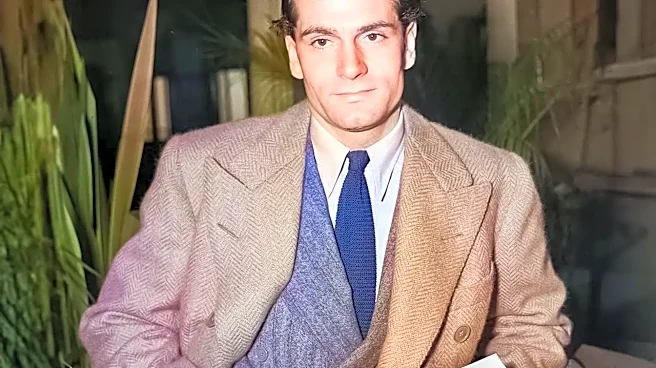
When Laurence Olivier arrived on the London stage in the late 1920s, he was a handsome, hungry talent who quickly distinguished himself from his more vocally gifted contemporaries, John Gielgud and Ralph Richardson. While Gielgud possessed a voice critics
praised as pure poetry, Olivier brought a raw, physical energy and a dangerous passion that felt utterly new. One famous production of 'Romeo and Juliet' saw them alternate roles, with a common verdict being that Gielgud spoke the verse beautifully, but Olivier truly seemed in love. This combination of technical craft and untamed charisma propelled him into early West End stardom and his first film roles in the 1930s, positioning him as a rival to both the British stage establishment and Hollywood's suave leading men like Clark Gable and Spencer Tracy.
Conquering Two Continents
By the late 1930s and 1940s, Olivier had achieved a rare dual dominance. He became a bona fide Hollywood movie star with brooding, romantic turns in 'Wuthering Heights' (1939) and 'Rebecca' (1940). He later credited 'Wuthering Heights' director William Wyler with teaching him how to modulate his powerful stage presence for the intimacy of the camera. Not content with screen stardom, he returned to England and, during World War II, directed and starred in a trilogy of Shakespeare films—'Henry V,' 'Hamlet,' and 'Richard III.' These weren't just filmed plays; they were dynamic cinematic events that made Shakespeare accessible to a global audience and cemented Olivier's reputation. 'Hamlet' (1948) won him Academy Awards for Best Picture and Best Actor, a feat no one has repeated for a Shakespearean role.
The Method Rebels and The Entertainer
The 1950s brought the biggest threat to Olivier’s reign. A new generation of American actors, led by Marlon Brando, Montgomery Clift, and James Dean, exploded onto the scene with a raw, internalized style known as 'The Method.' Their mumbling vulnerability made Olivier’s precise, external technique seem potentially old-fashioned. While privately infuriated by the new style, Olivier proved his adaptability. In 1957, he took on the lead role in John Osborne's avant-garde play 'The Entertainer,' playing a washed-up, pathetic music-hall comic named Archie Rice. The role was a stunning reinvention, merging his classical skill with the raw-nerve realism of the new era and earning him another Oscar nomination for the 1960 film version. It was a strategic masterstroke, proving he could not only compete with the new guard but also absorb their strengths.
The Elder Statesman and Enduring Power
Instead of fading away, Olivier’s final decades were a masterclass in institutionalizing his legacy and pivoting his career. From 1963 to 1973, he served as the founding director of Britain's National Theatre, shaping the next generation of talent. As his own leading man days waned, he transformed into the world's most formidable character actor. He stole scenes from the very stars who had once been the young rebels. He went toe-to-toe with Michael Caine in 'Sleuth' (1972) and Dustin Hoffman in 'Marathon Man' (1976), famously chiding his Method-acting co-star's on-set dedication with the legendary quip, "My dear boy, why not try acting?" These late-career roles, including in 'The Boys from Brazil' (1978), earned him a string of Oscar nominations, keeping him relevant long after his original contemporaries had retired or passed on.