






The American Tailgate Doctrine
First, let's establish the gospel. American college football tailgating isn't just a pre-game activity; it’s a quasi-religious rite. It’s a parking lot transformed into a temporary city, governed by its own laws of hospitality and hickory smoke. The doctrine
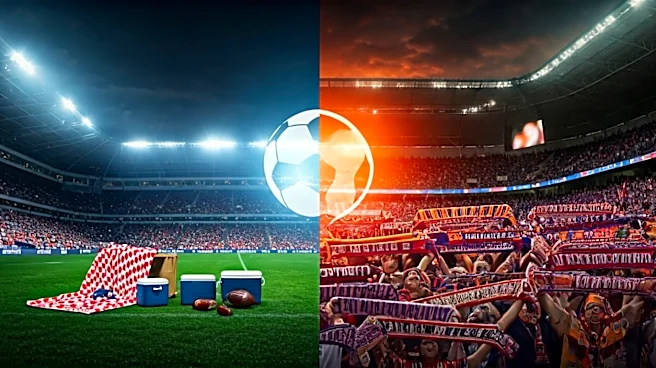
is clear: you arrive early, you claim your territory with a pop-up tent, and you come prepared. Preparation means a multi-generational feast—chili simmering in a slow cooker, burgers sizzling on a portable grill, and a cooler so meticulously packed it would make a Tetris master weep with pride. This is a stationary, hours-long affair. The vehicle is the anchor, the base camp from which all social activity radiates. It’s about creating a home outside the home, a patch of asphalt that becomes a sacred space for community, friendly rivalries, and the consumption of school-color-coordinated Jell-O shots. It’s less about a march to victory and more about a day-long festival where a football game just happens to break out.
The Global Soccer Carnival
Now, pivot to the pre-game ritual for a World Cup or a major European match. It’s a completely different beast. The energy is kinetic, not stationary. The primary venue isn’t a parking lot but the city itself. Fans from opposing nations take over public squares, their songs and chants echoing off historic architecture. The ritual is a pilgrimage, a collective march from a downtown pub to the stadium, growing in size and volume with every block. The 'pre-game' is a fluid pub crawl, a sea of scarves and flags flowing through cobblestone streets. Food is often a handheld affair—a sausage from a street vendor, a meat pie grabbed on the go. The focus isn't on elaborate setups but on shared, vocal passion. It’s mobile, nomadic, and built around the journey to the stadium, culminating in a unified roar as fans stream through the turnstiles. The idea of setting up a grill and a lounge chair is as foreign as calling the sport 'soccer.'
Where Parking Lots Meet Pub Crawls
So, how do you fit the square peg of an American tailgate into the round hole of a global soccer match? You don’t. You build a new shape. American soccer fans, particularly organized groups like the American Outlaws, have become masters of cultural fusion. They’ve created a hybrid model that honors the spirit of tailgating without the literal parking lot. When the U.S. Men’s National Team plays abroad, these fans don't ship their Weber grills overseas. Instead, they colonize a local bar or event space for a massive, all-day party. The principles of the tailgate remain: it starts early, there’s an abundance of American beer, and it’s a centralized gathering point for U.S. fans. They might swap burgers for whatever the local specialty is, but the communal spirit is identical. When matches are stateside, the full tailgate experience emerges, but with a soccer twist. You’ll see the same grills and coolers, but the soundtrack might be less country music and more “I Believe That We Will Win!” chanted on a loop. It’s the tailgate doctrine, adapted for a new congregation.
A Homecoming for the Hybrid Fan
This cultural experiment is about to have its ultimate showcase. The 2026 FIFA World Cup, hosted across North America, won’t just be the biggest in history; it will be the definitive moment for the American soccer fan’s identity. For the first time, hundreds of thousands of international fans will descend on NFL-sized stadiums surrounded by acres of… parking lots. Imagine it: German fans, accustomed to pre-game beers in a city square, wandering into a Kansas City tailgate with 50,000 Americans. Brazilian fans, masters of the street party, encountering the uniquely American spectacle of a cornhole tournament outside MetLife Stadium. The 2026 World Cup will be the ultimate home-field advantage for this hybrid fan culture. It will be the moment the world doesn’t just see America’s passion for soccer, but experiences the unique, slightly strange, and wonderfully welcoming way Americans prepare for a big game.