





Gather Your Research Equipment
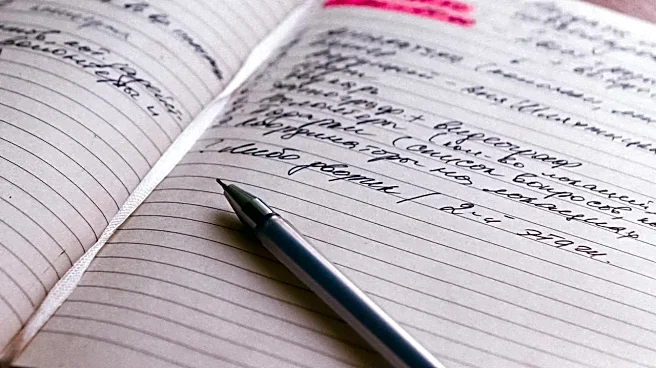
Before you settle in for your rewatch, assemble your tools. You don't need a state-of-the-art laboratory; a simple setup will suffice. Start with a sturdy, blank notebook—A5 or larger is ideal to give you space for notes, diagrams, and data. Choose your favorite
pens, but consider a multi-color set. Designating colors for different subjects (e.g., blue for Astrophage biology, green for Eridian notes, red for engineering problems) can make your log much easier to parse. Sticky tabs are also invaluable for sectioning your notebook. You might label them "Mission Timeline," "Astrophage," "Eridian," and "Engineering." Finally, keep your device handy. You’re not just watching; you’re cross-referencing, pausing to sketch a ship component, and capturing the essence of Ryland Grace’s scientific process.
Establish Your Mission Log
The first section of your notebook should be the Mission Log. This is where you’ll track the story's timeline, which, as fans know, jumps between Grace’s present on the Hail Mary and his past on Earth. A two-column layout works perfectly here. On the left, log the “present-day” events aboard the ship, from Grace’s awakening to his first contact with Rocky. On the right, document the flashbacks as they appear: Grace’s recruitment by Eva Stratt, the initial discovery of Astrophage, and the frantic race to build the ship. Note down key plot points, character interactions, and the elapsed time as mentioned in the story. This chronological record will serve as the backbone of your entire notebook, providing context for all the scientific deep dives to come.
The Astrophage Files
Dedicate a substantial section to the star of the show (and the eater of them): Astrophage. This is where you document every detail about the alien microbe. Start with its basic properties: how it absorbs energy, travels between stars, and reproduces using a planet's atmosphere. Note its life cycle, from enriching itself on a star to reproducing on a planet like Venus. Log the discovery of the "Petrova line," the infrared signature that first alerted humanity to its existence. As the story progresses, add more complex details. How is it used as fuel for the Hail Mary? What are its properties as a radiation shield? Don't forget to track its natural predator, the Taumoeba, which becomes the key to saving both Earth and Erid. This section will become a comprehensive profile of one of science fiction’s most fascinating organisms.
Xenobiology: Eridian Studies
Your next section is for humanity's new best friend, Rocky. This is your chance to be a xenobiologist. Document everything you learn about Eridian biology and culture. Start with physiology: the five-legged, spider-like appearance, the ammonia-based atmosphere, and the incredibly high-pressure environment of their home world, Erid. Note their unique method of seeing via echolocation due to Erid's lightless surface. Delve into their language, a complex series of musical chords and tones. You can even try to map out a few key phrases Rocky uses. Pay close attention to the descriptions of Eridian technology and how it differs from humanity's—they are masters of engineering but had not discovered principles like relativity. This log is a tribute to the power of interspecies friendship and collaboration.
Engineering and Physics Log
This section is for the 'hard' science that Andy Weir is famous for. Track the specifications and functions of the Hail Mary itself. How does the ship generate artificial gravity through rotation? How does it achieve its incredible acceleration? Use this space to sketch out the ship's design, from the rotating crew section to the fixed fuel/engine segment. You can also log the physics concepts that play a major role in the plot, such as relativity and time dilation during the interstellar journey. When Grace has to solve a problem—like creating a makeshift lab to study Rocky's biology or jury-rigging a solution for the Taumoeba breeding tanks—note down his process. This part of your notebook celebrates the ingenuity and problem-solving at the heart of the story.
The "Amaze!" Dossier
Finally, every good science notebook needs a space for miscellaneous thoughts, brilliant quotes, and moments of pure wonder. Call it the "Amaze!" dossier. This is where you can jot down your favorite lines from Grace and Rocky. Sketch a doodle of Rocky's three-fingered hands or the Blip-A probe. Write down questions you have about the science or plot points that made you think. This is the creative, personal part of your log. It’s less about rigorous data collection and more about capturing the fun, heart, and soul of the adventure. After all, science is not just about facts and figures; it's also about curiosity, excitement, and the joy of discovery. Amaze!