







In the world of Panem, survival is a contest against a rigged system. With 'Sunrise on the Reaping,' the story of Haymitch Abernathy’s games, we see the Capitol's cruelty in a new light: its power to turn nature itself into the ultimate cage.
Panem's Original Sin: Corrupting the Wild
From the
very beginning, the Hunger Games series established a core conflict between humanity and a twisted, weaponized version of nature. For characters like Katniss Everdeen, the woods outside District 12 were a sanctuary, a place of freedom and sustenance. It was where she learned to hunt, gather, and be herself, away from the Capitol's prying eyes. Yet, inside the arena, that same knowledge became a tool for survival in a horrifyingly artificial environment. The Gamemakers' power wasn't just in creating monsters, but in their ability to take something as pure as a forest or a stream and turn it into an instrument of death. 'Sunrise on the Reaping' takes this theme and pushes it to its most terrifying extreme, showing that before Katniss ever stepped into her arena, the Capitol had already perfected the art of making the very earth a killer.
The Poison Paradise of the Second Quarter Quell
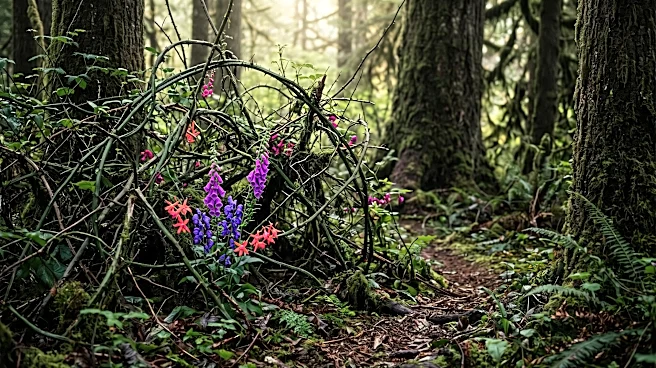
Haymitch Abernathy's victory in the 50th Hunger Games, the Second Quarter Quell, wasn't just against 47 other tributes—it was against an entire ecosystem designed to kill him. The arena for his games was, by all accounts, beautiful. It featured lush meadows, vibrant woods, and a picturesque snow-capped mountain. But this beauty was a facade. In this 'poison paradise,' everything was lethal. The water, the plants, and even the sweet-smelling flowers were toxic. The only safe resources were the supplies at the Cornucopia, forcing a bloodbath from the start. Carnivorous squirrels and poison-dart-wielding birds were just some of the genetically engineered 'muttations' released. This arena was the Capitol's philosophy made manifest: that there is no true sanctuary, that even the most idyllic landscape can be corrupted and turned against you. It was a psychological masterstroke, designed to break the tributes' spirits by showing them that nothing in their world, not even a blade of grass, was safe from the Capitol's touch.
A Different Kind of Survival
Unlike Katniss, who could rely on her deep, almost instinctual knowledge of the wild, Haymitch was thrown into an environment where those rules were inverted. Where Katniss could identify edible plants, Haymitch had to assume everything was a threat. His survival depended less on living in harmony with nature and more on outsmarting the artificial death-trap it had become. He formed a crucial alliance with Maysilee Donner, who cleverly used the arena's own poisons to weaponize her blowgun darts. But Haymitch's ultimate victory came from understanding the arena's artificiality. By discovering the force field at the edge of the arena and using it to turn his final opponent's weapon against her, he wasn't just defeating another tribute; he was beating the Gamemakers at their own game. It was an act of defiance that showed he saw the arena not as a natural space, but as the machine it truly was.
The Symbolism of a Tainted World
The weaponization of nature in 'Sunrise on the Reaping' is more than just a creative way to raise the stakes. It's a powerful symbol of the Capitol's total control. In a totalitarian state, power is maintained not just through force, but by eroding the people's connection to anything pure or independent. By turning nature into a source of fear, the Capitol severs a fundamental bond, suggesting that there is no escape and no world outside of its influence. Panem itself is born from ecological disaster, a society built on the ruins of a world that failed to respect nature. The Games, therefore, become a perverse annual ritual where that original sin is re_enacted. The Capitol's ability to manipulate weather, create monstrous animals, and make a flower's scent deadly is the ultimate expression of its arrogance and its desire to play God. It’s a chilling reminder that the greatest threat isn't always the visible enemy, but the corruption of any world you stand on.