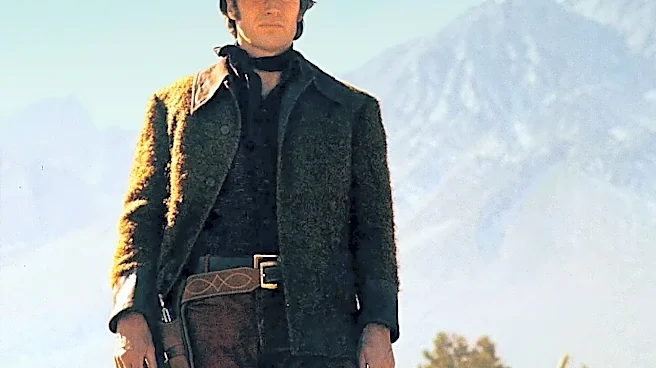



John Wayne in 'The Man Who Shot Liberty Valance'
In John Ford’s classic 1962 Western, Lee Marvin’s sadistic outlaw, Liberty Valance, is the brutal force of nature threatening to tear the town of Shinbone apart. Standing against him are two titans of the screen: James Stewart as the man of law and John Wayne
as the man of the frontier. The dynamic between Marvin’s sneering villainy and Wayne’s stoic heroism is the stuff of legend. Wayne, already an icon, embodies the myth of the Old West, making his confrontation with the newer, more senseless violence of Valance a poignant clash of eras. Their face-offs are a masterclass in screen presence. After seeing them together, dive into Wayne's vast filmography with 'The Searchers' (1956), a complex and haunting performance often cited as his greatest work.
Jane Fonda in 'Cat Ballou'
Marvin won his only Oscar for his dual role in this 1965 comedy Western, but his performance wouldn’t shine so brightly without Jane Fonda in the title role. Fonda plays Catherine Ballou, a prim schoolteacher who becomes an outlaw to avenge her father. She hires the legendary (and legendarily drunk) gunfighter Kid Shelleen (Marvin) for protection. Fonda’s earnest and increasingly determined Cat is the perfect foil for Marvin’s hilarious, stumbling anti-hero. Their chemistry is pure comedic gold. Fonda was just becoming a major star, and her energy here is infectious. To see her dramatic power, watch 'Klute' (1971), for which she won her first Oscar, playing a high-class call girl caught in a terrifying mystery.
Angie Dickinson in 'Point Blank'
John Boorman’s 1967 neo-noir 'Point Blank' is a stark, stylish revenge thriller, and Lee Marvin’s Walker is one of cinema’s most relentless protagonists. Betrayed and left for dead, he tears through the criminal underworld to get his money back. The only person who seems to exist on his level is Chris, played with cool, dangerous intelligence by Angie Dickinson. As the sister of Walker's unfaithful wife, her relationship with him is a complex dance of fear, attraction, and self-preservation. Dickinson is no mere damsel; she’s a survivor who matches Marvin’s intensity, look for look. For another iconic Dickinson role, check out Howard Hawks’ 'Rio Bravo' (1959), where she holds her own against John Wayne and Dean Martin.
Burt Lancaster in 'The Professionals'
This 1966 action-Western assembles a team of specialists for a rescue mission in Mexico, and it’s a showcase for masculine star power. Lee Marvin is the pragmatic leader, Rico Fardan, but the film’s charm and swagger come from Burt Lancaster as Bill Dolworth, the explosives expert with a dazzling grin and a rebellious streak. While Marvin is all coiled steel and strategy, Lancaster is the charismatic rogue. The interplay between them—two seasoned pros who respect but don't entirely trust each other—is a joy to watch. To see Lancaster’s darker, more obsessive side, his Oscar-winning turn as a charismatic con man in 'Elmer Gantry' (1960) is essential viewing.
Charles Bronson in 'The Dirty Dozen'
In a film packed with tough guys, it’s hard to stand out, but Charles Bronson manages it. Robert Aldrich’s 1967 World War II classic features Marvin as the rebellious Major Reisman, tasked with training a squad of military convicts for a suicide mission. Among them is Joseph Wladislaw, played by Bronson with a quiet, simmering intensity that makes him a natural, albeit reluctant, second-in-command. Marvin and Bronson, who both served in WWII, bring an authenticity to their roles. Their shared understanding of military hierarchy and quiet defiance makes their dynamic believable. To see Bronson take center stage, watch Sergio Leone’s masterpiece 'Once Upon a Time in the West' (1968), where he plays the mysterious, harmonica-playing hero.
Ernest Borgnine in 'Emperor of the North'
Few on-screen rivalries are as brutal and visceral as the one between Marvin and Ernest Borgnine in this 1973 cult classic. During the Great Depression, Marvin plays A-No.-1, a legendary hobo determined to be the first to ride the train of the sadistic conductor Shack (Borgnine), who has a personal vendetta against anyone trying to ride for free. The film is essentially a two-hour battle of wills between two incredibly stubborn, violent men. Borgnine, often known for more genial roles, is terrifying as Shack, a monster of pure malice. Their climactic fight with chains and hammers is unforgettable. For a complete contrast, watch Borgnine in his Oscar-winning role as a lonely, gentle butcher in 'Marty' (1955).
Vivien Leigh in 'Ship of Fools'
This 1965 drama, set aboard an ocean liner in 1933 with a cross-section of society heading toward Nazi Germany, provided the final film role for the legendary Vivien Leigh. She plays a faded, flirty Southern belle, and among her shipmates is Lee Marvin as a boorish, washed-up baseball player. Their scenes together are a fascinating, poignant contrast of acting styles and personas. Marvin’s raw, American machismo bumps up against Leigh’s fragile, theatrical grandeur. It's a meeting of two different Hollywoods. Marvin won an award for his role, but watching Leigh, frail but still luminous, is the main draw. To witness her at the height of her powers, her two Oscar-winning performances in 'Gone with the Wind' (1939) and 'A Streetcar Named Desire' (1951) are required viewing.