







The Authenticity Problem
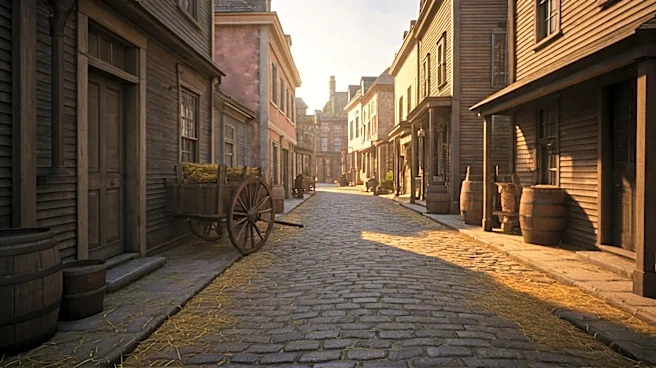
When you watch a series like HBO’s “John Adams” or AMC's "Turn: Washington's Spies," the goal is immersion. You’re meant to believe you're walking the muddy, chaotic streets of Boston or New York in the 1770s. The problem is, a truly populated 18th-century
street was a messy, dense ecosystem of merchants, artisans, children, and animals. Replicating that authentically is one of the biggest hidden costs in period filmmaking. It’s not just about getting a few people in costume; it’s about creating a believable world from scratch, and every single element, from a background actor's worn-out shoes to the pig running across the road, has a price tag. This financial and logistical challenge is why many historical productions feel oddly empty—the sheer expense of 'filling the frame' is often too high.
The Cost of a Single Person
The most fundamental cost is the people themselves. A background actor, or extra, is the basic building block of a crowd. According to the Screen Actors Guild (SAG-AFTRA), the basic daily rate for a background actor on a major production can be over $200 for an eight-hour day, and that's just the start. For a period piece, that actor also needs a costume fitting, which costs more time and money. They need period-specific hair and makeup, which requires specialized artists. And you don't just need one; you need dozens, sometimes hundreds, to make a street feel alive. For a production shooting for several days, those costs multiply quickly. A scene requiring 100 extras for three days could easily run into six figures just for the human element, before a single prop is placed or camera rolls.
Dressing the Masses
Costuming a principal cast is a major undertaking; costuming a hundred extras is a logistical nightmare. For productions striving for accuracy, like “John Adams”—which won awards for its meticulous costuming—you can’t just buy colonial outfits off the rack. Each social class, profession, and region had distinct clothing. This means costume departments face a constant “make or rent” dilemma. Creating hundreds of bespoke outfits is astronomically expensive and time-consuming. Renting from costume houses is more economical but can lead to a generic look or inaccuracies, something dedicated fan bases and historians quickly notice. Sometimes, productions reuse costumes from other films to save money—a clever trick unless eagle-eyed viewers spot a redcoat uniform from “The Patriot” marching through a scene in “Turn.”
The Trouble with Locations
Finding a pristine colonial street in the 21st century is nearly impossible. Most historical districts have modern intrusions: asphalt, streetlights, fire hydrants, and telephone wires. This leaves productions with two costly choices. First, they can build a set from the ground up, an enormous expense reserved for only the biggest budgets—the $100 million budget for “John Adams,” for instance, allowed for extensive set construction. The more common approach is to find a suitable location and then painstakingly cover or disguise modern elements. This involves everything from laying down tons of dirt to hide pavement to using clever camera angles. Every minute spent hiding a modern-day sign is a minute of paid crew time, adding to the day’s budget.
The Rise of the Digital Crowd
For decades, the only way to show a crowd was to hire one. Today, visual effects (VFX) offer a powerful alternative. Crowd simulation software can create hundreds or thousands of digital extras to populate a scene, from filling a city square to creating massive armies for a battle. This isn't necessarily cheap—a single, complex VFX shot can cost tens of thousands of dollars—but it often proves more cost-effective than the real-world logistics of hiring, costuming, feeding, and managing hundreds of actual people. Productions now often use a hybrid approach: a core group of 20-50 real extras are placed in the foreground for close-ups and interactions, while the mid-ground and background are filled with digital clones and entirely computer-generated characters. This creates the illusion of a massive crowd without the corresponding massive on-set expense.