





The Bombshell Arrives
To understand the bikini’s power, you have to remember a time when it was pure scandal. Invented in 1946 by French engineer Louis Réard, the two-piece was so shocking that no Parisian model would wear it; he had to hire a nude dancer instead. For years,
it remained a European novelty, too risqué for mainstream America. Then came the movies. The moment that truly weaponized the bikini wasn't black, but it created the blueprint. When Ursula Andress emerged from the Caribbean surf in 1962’s *Dr. No*, her white bikini, complete with a utilitarian knife belt, wasn’t just swimwear—it was armor. This ‘Bond Girl’ moment established the bikini as a symbol of a new kind of woman: independent, fearless, and unapologetically sensual. She wasn't a pin-up waiting to be looked at; she was an active participant in her own story. The bikini became shorthand for fantasy, danger, and a potent, almost startling female agency that Hollywood, and soon the world, couldn't ignore.
From Silver Screen to Main Street
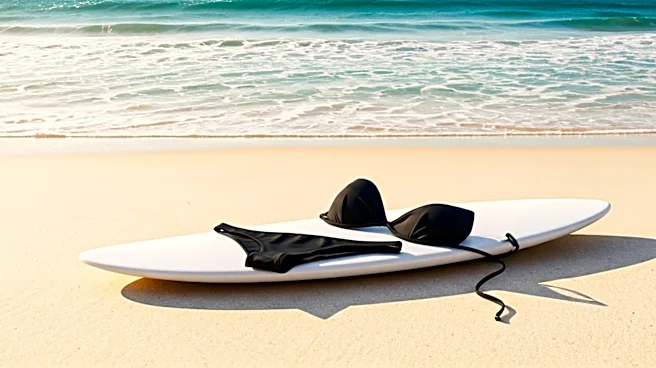
While cinematic bombshells like Raquel Welch in *One Million Years B.C.* kept the fantasy alive, the 1970s saw the bikini transition from a Hollywood costume to a poolside reality. As the social revolutions of the late ‘60s took hold, baring one’s midriff was no longer a radical act but a sign of liberation. This is where the *black* bikini began its ascent. While psychedelic prints and crochet designs defined the hippie aesthetic, the simple black two-piece offered something different: sophistication. It was the ‘little black dress’ of the beach, a classic choice that conveyed confidence without shouting. It didn't rely on trends. Instead, it drew attention to the woman wearing it. The black bikini became the choice for those who wanted to look chic and timeless, channeling a European Riviera sensibility even on a public American beach. It was less about being a bombshell and more about being self-possessed and elegant.
The Supermodel Era and Minimalist Chic
By the late 1980s and 1990s, the bikini had a new set of ambassadors: the supermodels. On the covers of *Sports Illustrated* and *Vogue*, figures like Cindy Crawford, Naomi Campbell, and Elle Macpherson transformed the perception of the bikini body. It was no longer just about soft curves; it was about strength, athleticism, and power. The black bikini was central to this era’s aesthetic. Often styled in high-cut, minimalist designs, it emphasized long legs and toned physiques. This was fashion with a capital F. The stark, graphic simplicity of a black triangle top and high-waisted bottom became a uniform for the world’s most famous women, cementing its status as a high-fashion staple. It was no longer just for the beach; it was part of a broader minimalist movement that celebrated clean lines and understated confidence. The black bikini was the epitome of ‘90s cool—effortless, powerful, and undeniably sexy.
The Influencer's Uniform
Today, the black bikini has completed its journey from scandalous outlier to ubiquitous uniform. Scroll through Instagram from any sun-drenched location—a Mykonos beach club, a Tulum resort, a celebrity’s yacht—and you’ll find it. In the age of the influencer, the black bikini is the ultimate canvas. It’s a backdrop, not a distraction. It allows the person, the location, and the curated lifestyle to be the focus. It’s flattering on virtually every skin tone and body type, making it a democratic choice in an era of body positivity. But it also telegraphs a certain kind of modern luxury: quiet confidence. It says you don't need loud patterns or complicated straps to make a statement. Its power now lies in its subtlety. It’s the default choice for the vacation wardrobe because it’s both safe and incredibly effective, a reliable tool for projecting an image of effortless, sun-kissed chic.