



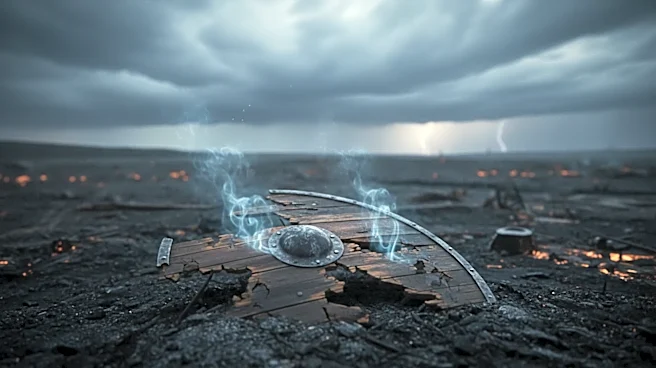


The Underworld Awaits: Book 11
The single hardest part of the Odyssey to translate to film is Book 11, the Nekuia, where Odysseus travels to the land of the Cimmerians to consult the dead. Guided by the sorceress Circe, he doesn't physically descend into Hades but performs a ritual
to summon the shades of the departed. He digs a trench, pours libations, and sacrifices sheep, whose blood allows the ghosts to speak. While a journey to the underworld is a staple of heroic myth, from Orpheus to Hercules, the Nekuia is uniquely difficult because its power is not in action or spectacle, but in its quiet, mournful, and deeply un-cinematic conversations. It is the spiritual and philosophical heart of the epic, and its challenges reveal the vast gulf that can exist between literary and visual storytelling.
The Problem of a Ghostly Q&A
Modern film thrives on subtext and momentum. The Nekuia, by contrast, is a sequence of static, somber interviews. Odysseus speaks with his fallen crewmate Elpenor, the blind prophet Tiresias, his own mother Anticlea, and a parade of heroes from the Trojan War like Agamemnon and Achilles. Each conversation is an info-dump. Tiresias delivers a prophecy that outlines the rest of the journey. Agamemnon warns of betrayal at home. Achilles delivers his famous, haunting line that he’d rather be a poor farmer among the living than a king among the dead. These are profound, character-defining moments, but they are delivered as direct, soul-baring testimony. In a film, this risks becoming a long, visually dull succession of talking heads, draining the narrative of the very tension it’s trying to build. The sequence is pivotal for Odysseus's character, but it brings the external plot to a complete halt.
A Journey Without a Destination
Unlike cinematic underworlds seen in films from Disney's "Hercules" to "What Dreams May Come," Odysseus’s Nekuia isn't a physical quest through a terrifying landscape. He stands at the edge of a pit in a land of perpetual mist. The horror is psychological and existential, not visual. The shades are described as witless, gibbering things until they drink the dark blood, a detail that’s hard to portray with dignity. Odysseus tries to embrace the shade of his mother three times, only for her to dissolve like a shadow or a dream in his arms. How do you film that without it looking clumsy or melodramatic? The power of the scene on the page comes from the internal, emotional devastation, but film is an external medium. It demands a visual world, and the Nekuia offers only fog, a trench, and a parade of sorrowful ghosts.
Spectacle Versus Substance
Filmmakers are often tempted to solve these problems by inventing spectacle. The 1997 miniseries, for instance, turned the Nekuia into a more traditional descent into a fiery, cavernous hell. While visually more engaging, this misses the point. The horror of Homer's vision is its quiet emptiness and the profound sadness of the shades. The Nekuia is not an action set piece; it is a meditation on memory, grief, and the brutal finality of death. It’s a chapter about listening, not fighting. To make it a visual spectacle is to betray its core theme. To keep it faithful to the text is to risk creating a scene that feels static and dramatically inert on screen. This fundamental conflict is why the Nekuia remains the epic’s unconquerable peak for any filmmaker brave enough to attempt it.