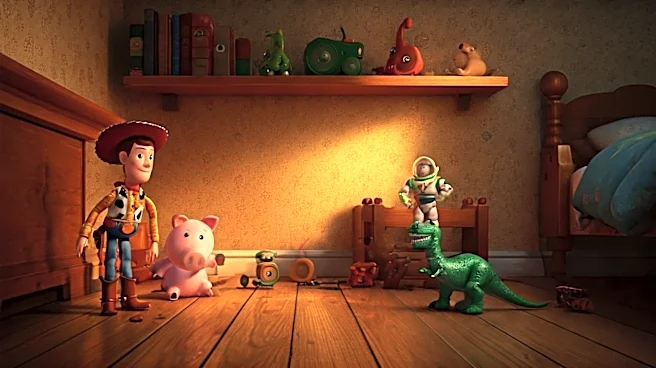






The Franchise's Golden Rule
For four films, the Toy Story universe has revolved around a single, unspoken rule: the child is the source of all purpose and joy. They are the sun around which the toy-planets orbit. The central conflict is never *with* the child; it’s about getting
back *to* the child. Andy wasn’t a problem; losing him was. Even Sid, the destructive kid-next-door from the first film, wasn't a true villain so much as a force of nature—a chaotic, ignorant god who didn’t understand his playthings were alive. The real antagonists have always come from within the toy world: jealous rivals like the original Buzz Lightyear, bitter outcasts like Stinky Pete, traumatized dictators like Lotso, or desperate wannabes like Gabby Gabby. The child’s love has always been the goal, the reward, and the entire point of a toy’s existence. It’s the emotional bedrock of the series, the one thing that has remained non-negotiable.
A Legacy of Unconditional Love
This rule reached its emotional apex at the end of *Toy Story 3*. The scene where Andy passes his beloved companions to Bonnie is more than a bittersweet farewell; it’s a canonization of this core theme. He doesn’t just give them away; he shares their stories, their meaning, and their value. He entrusts their purpose to a new generation. Bonnie, in turn, accepts this responsibility with wide-eyed wonder. The toys’ existential crisis of obsolescence is solved by the redemptive power of a new, loving child. This moment was so powerful and felt so final precisely because it was the ultimate affirmation of the franchise's ethos. For a toy, being loved by a kid is heaven. The worst possible fate isn’t being broken; it’s being unloved and forgotten in an attic or a landfill.
How 'Toy Story 4' Cracked the Foundation
Then came *Toy Story 4*, a film that many felt was unnecessary but which quietly planted the seeds for a franchise-altering idea. When Woody chooses to leave Bonnie to become a “lost toy” with Bo Peep, he makes a radical decision. For the first time, a main character willingly severs the sacred bond with his kid. He finds a new purpose not in serving one child, but in helping all toys find their way to others. While noble, this act fundamentally questions the golden rule. It suggests a toy’s life can have meaning *outside* the confines of a single kid’s bedroom. Bonnie wasn’t a bad kid, but she preferred other toys, rendering Woody’s devotion redundant. His departure was the first sign that the child-toy relationship wasn’t the only path to fulfillment. It was a crack in the very foundation the first three movies were built on.
The Final Frontier: A 'Problem' Child
With Woody gone and the original premise already questioned, where can *Toy Story 5* possibly go? Another story about a lost toy getting back to its owner feels repetitive. The only truly new, emotionally resonant territory left to explore is the inversion of its most sacred rule. Imagine Buzz, Jessie, and the gang belonging to a child who isn't just neglectful, but actively cruel, manipulative, or simply… broken. Not a monster like Sid, but a child who reflects a more complicated, modern reality—perhaps one who is addicted to screens, isolated, or who sees toys as disposable objects for TikTok clout rather than friends. This would present the remaining toys with an impossible dilemma. Their entire existence is predicated on bringing joy to a child. What do they do when the child rejects that joy or is incapable of receiving it? Do they try to “fix” the child? Do they abandon them, confirming Woody’s choice was the right one? Or do they find a way to love a kid who is seemingly unlovable? This would shift the emotional stakes from “we have to get back to our kid” to “what is our purpose if our kid is the problem?”