




Setting the Stage
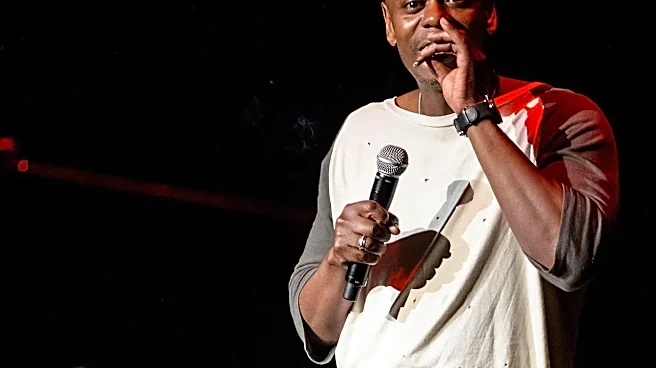
When ‘The Dreamer’ landed on Netflix, audiences largely knew what to expect: sharp observations, controversial jabs, and the singular cadence of a comedian who has spent the last several years as a cultural lightning rod. The special delivers on those
fronts. Chappelle tackles the Will Smith slap with a unique perspective only he could have, reflecting on his own on-stage attack. And yes, he wades back into the territory of gender and identity that has defined much of the recent conversation around his work. For many, the special felt like another chapter in the same book, mixing undeniable comedic genius with a stubborn insistence on “punching down.” But beneath the surface-level provocations, Chappelle was building a larger, more personal thesis that only becomes clear in the final moments.
The So-Called 'Hidden Sketch'
The defining moment of ‘The Dreamer’ isn't a sketch at all—it's a story. For most of the special, the title feels abstract, a general theme about ambition. But at the end, Chappelle ties it all together with a long, reflective anecdote about a lesson he learned from his father. He explains his father’s philosophy: “In your life, at any given moment, the strongest dream in that moment wins that moment.” This isn’t just a poignant memory; it's the thematic framework for everything that came before it. Chappelle presents this idea not as a punchline, but as the central message he wants the audience to carry with them. He posits that he is a “very powerful dreamer,” having envisioned his current life as a 14-year-old boy and now living it as a 50-year-old man.
The Jim Carrey Connection
The theme of dreams is seeded from the very first story Chappelle tells, which initially feels like a long walk for a controversial punchline. He recounts visiting the set of 'Man on the Moon' and meeting his idol, Jim Carrey, who was so deep in character as Andy Kaufman that he refused to acknowledge Chappelle. Chappelle uses this bizarre encounter—seeing Carrey but being told he was Kaufman—as a convoluted metaphor for his feelings about trans people, a joke that many critics found lazy and repetitive. However, when viewed through the lens of the special’s closing statement, the story takes on a different weight. It becomes an early example of a powerful dreamer (Carrey as Kaufman) imposing his reality on the entire room. Chappelle, the young, aspiring comedian, is merely a player in someone else's dream, a concept that clearly stuck with him.
The Unifying Theory of 'The Dreamer'
This closing philosophy—“the strongest dream wins”—reframes the entire special. It becomes Chappelle’s ultimate defense of his own controversial path. When he discusses the Will Smith slap, he sees two powerful but competing dreams clashing in a single moment. When he jokes about his various targets, he is, in his own framing, simply asserting that his dream of what comedy can be is stronger than the competing dream of what it should be. The special itself, filmed in his hometown of Washington, D.C., where he first started, is presented as the culmination of a lifelong dream. He concludes by turning this idea toward the audience, telling them he is honored to be a part of their dream of seeing him perform. It’s a masterful piece of rhetoric that positions him not as an antagonist, but as the ultimate self-actualized individual, living out a vision he’s held for decades.