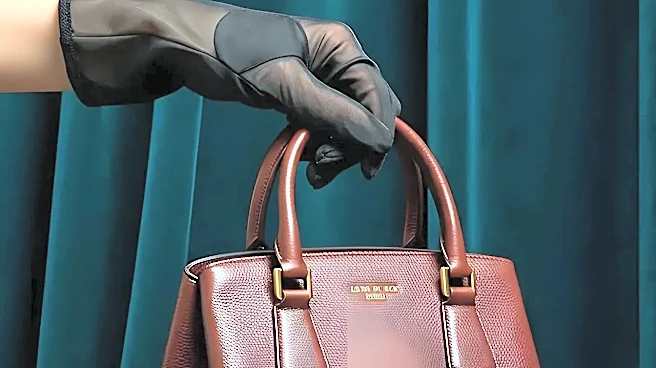

The 'Ludicrously Capacious' Status Symbol
Perhaps no piece of dialogue has ever so perfectly captured the power of a handbag as a status signifier than in HBO's 'Succession'. When Tom Wambsgans mercilessly mocks a guest's large, check-patterned
Burberry tote as 'ludicrously capacious', he isn't just being cruel; he's enforcing the social code of the ultra-wealthy. In their world of 'stealth wealth', true power means not having to carry anything at all. A giant bag suggests you might have packed flat shoes for the subway or your own lunch—activities anathema to the Roy family. The bag, though expensive, screamed 'outsider' because it was trying too hard. It was a visual cue that its owner didn't belong, proving that in the highest echelons, what you don't carry is more important than what you do.
The Bottomless Bag of Infinite Resources
On the opposite end of the spectrum is the magical, physics-defying bag. Mary Poppins' carpet bag, from which she pulls a floor lamp and a potted plant, is the quintessential example. This bag isn't about status; it's about preparedness, magic, and a boundless capacity for care. It signals that the owner is a problem-solver, someone who exists outside the normal rules of the universe to provide for others. We see a modern version in Hermione Granger's small beaded handbag, enchanted with an Undetectable Extension Charm. Inside, she carries a tent, books, clothes, and potions—everything needed to survive a months-long quest. The bag is a direct reflection of her brilliant, practical mind and her role as the trio's indispensable strategist. In both cases, the impossible bag makes the character a figure of ultimate competence and reliability.
The Utilitarian Pack of Survival
When a character's life is stripped down to its essentials, so is their bag. In action, dystopian, and adventure films, a bag's contents are a checklist for survival. Think of Indiana Jones' distressed leather satchel, a bag that looks like it has been through as many scrapes as he has. It carries artifacts and tools, not for show but for function, anchoring him in a world of gritty reality. Or consider the backpacks carried by characters in 'The Hunger Games' or 'The Walking Dead'. These bags are filled with water, meager rations, medical supplies, and makeshift weapons. There is no room for sentimentality or style. The bag becomes a stark symbol of a life lived on the edge, where every single item carried is a calculated decision in the service of making it to the next day.
The Anchor of a Former Life
Sometimes, a bag serves as a psychological anchor, a character's desperate link to a life that no longer exists. In Woody Allen's 'Blue Jasmine', Cate Blanchett's character, Jasmine, has lost everything after her husband's financial ruin. Yet, she clings to her personalized Louis Vuitton luggage and, most importantly, her camel-colored Hermès Birkin bag. She carries it everywhere, even to her working-class sister's apartment and her job as a receptionist. The bag, which cost more than the film's entire costume budget, is no longer a practical accessory but a talisman. It’s a constant, painful reminder of the wealth and status she once had, a physical manifestation of her inability to let go of her past and accept her new reality. The bag isn't just an accessory; it's the weight of her entire history.
The Power Move of Carrying Nothing
If a loud bag signals an outsider and a functional bag signals a survivor, what does no bag signal at all? Ultimate power. Miranda Priestly from 'The Devil Wears Prada' is the master of this. When she sweeps into the office, she doesn't carry a purse; she simply drops her coat and bag on her assistant's desk, expecting it to be handled. Her lack of a bag communicates something profound: the world is her accessory. She has staff for everything, from carrying her belongings to anticipating her needs. Her hands are free because she has an entire ecosystem of people to do the carrying for her. This absence is the most potent statement of status, suggesting a level of influence so immense that the practicalities of daily life are a complete afterthought, handled by others.