
The Agony of the Overlap
You’ve spent hundreds on a ticket, traveled across the country, and now you’re forced to make an impossible choice. It's a universal frustration for festival-goers. Do you catch the first half of the indie darling's set and then sprint a half-mile to see
the end of the legacy rock band's performance? Or do you plant yourself at one stage and accept defeat? This scheduling dilemma feels like a careless oversight or, worse, a cruel joke. But in reality, that conflict is often one of the most meticulously planned aspects of the entire event. The reason isn't to torture you; it's to keep you safe and the festival operational.
Welcome to Crowd Science
Event organizers rely on a field called pedestrian and crowd dynamics, which uses data and modeling to understand how large groups of people move. At its core, the science treats a crowd not as thousands of individuals making random choices, but as a single, complex system that can behave like a fluid. Researchers and planners use sophisticated computer simulations to model how attendees will flow through a festival ground. These programs can predict where bottlenecks will form, how queues will develop at food stalls or bathrooms, and what happens when tens of thousands of people try to move from one stage to another at the same time. By analyzing factors like path width, stage placement, and the location of attractions, they can game out dozens of scenarios to prevent dangerous levels of crowd density.
The Schedule as a Safety Tool
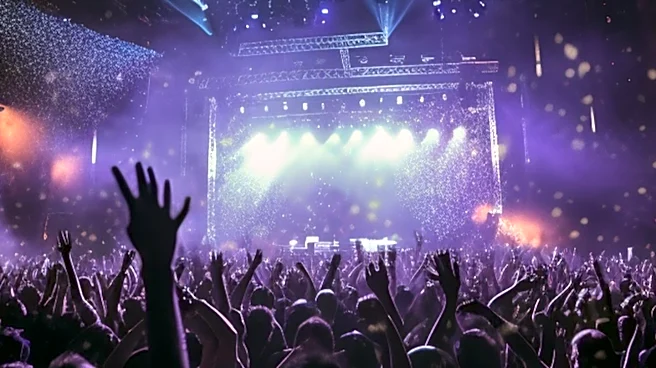
This is where schedule conflicts become a feature, not a bug. If every popular artist with a similar fanbase played at separate, unopposed times, it would create massive, unmanageable surges of people. Imagine 60,000 attendees all trying to cram into the space in front of a single main stage. The density would become dangerous, risking crushes and making medical emergencies nearly impossible to address. To prevent this, organizers use the schedule to strategically distribute the audience across the entire festival site. By scheduling two popular acts simultaneously at opposite ends of the venue, they effectively force the crowd to split. This intentional conflict is a powerful tool for managing flow, ensuring that no single area becomes dangerously overcrowded.
The Grand Festival Chessboard
The schedule is just one piece of the puzzle. Every element of a festival's layout is part of this grand strategy of crowd management. The placement of food vendors, beer gardens, art installations, and even bathrooms is carefully considered to influence how you move through the space. A winding path might feel inefficient, but it’s designed to slow down foot traffic. A popular food court might be placed far from the main stages to draw people away and create zones of lower density. Organizers use software to run countless "what-if" scenarios, modeling everything from an artist running late to a sudden downpour, all to ensure the site can handle the pressure. They analyze data from past events and even use real-time information from festival apps to identify potential crowding before it happens.