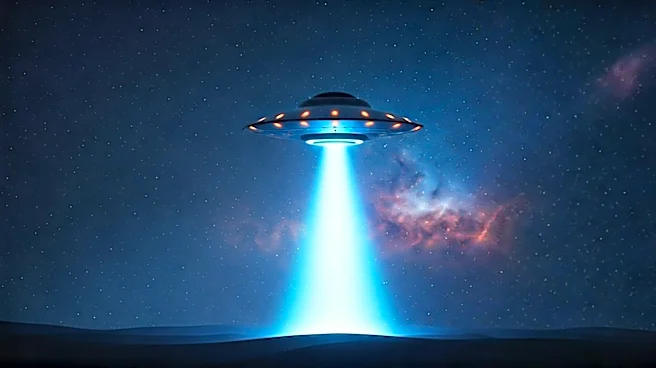










Start with Awe: Close Encounters (1977)
Before you can grapple with the political or existential dread, you must begin with pure, unadulterated wonder. *Close Encounters of the Third Kind* is not just a film; it's a baptism in cosmic awe. Spielberg bottles the feeling of looking up at the night
sky and knowing, with absolute certainty, that we are not alone—and that this might be a good thing. Roy Neary’s obsession isn’t madness, it’s a calling. The film’s aliens aren’t invaders; they are artists and mathematicians communicating through light and sound. The iconic five-tone musical phrase is the ultimate olive branch, a simple 'hello' from across the galaxy. Watching this first primes you for the best-case scenario: that first contact will be beautiful, strange, and profoundly moving. It’s the perfect emotional appetizer for a day dedicated to the unknown.
Embrace the Heart: E.T. (1982)
If *Close Encounters* is about humanity’s collective meeting with the stars, *E.T. the Extra-Terrestrial* is about the intensely personal one. This is the disclosure happening in your own backyard. Spielberg takes the grand cosmic mystery and scales it down to the story of a lonely boy who finds a friend. The government agents in black cars are the antagonists here, representing a system that fears what it cannot understand or control. E.T. isn't a specimen; he's a person. He gets sick, he misses his family, and he loves Reese's Pieces. The film is a powerful reminder that behind any potential disclosure are individuals—both theirs and ours. It forces the question: if a visitor landed tomorrow, would we greet them with scientific curiosity, bureaucratic paranoia, or the simple, open-hearted empathy of a child?
Confront the Fear: War of the Worlds (2005)
Alright, you've had your fill of hope and friendship. Time for a reality check. Spielberg’s 21st-century take on H.G. Wells’ classic novel is a brutal, terrifying, and necessary part of this marathon. Made in a post-9/11 America, this film swaps wonder for raw survival instinct. The tripods don't want to communicate, and they certainly don't want to be your friend. They are a force of nature, a biological scourge intent on terraforming our planet with our blood. This is the worst-case scenario, and it’s an important one to consider. Tom Cruise’s Ray Ferrier isn’t saving the world; he's just trying to save his kids. The film is a visceral gut-punch that strips away the romanticism of first contact and replaces it with the primal terror of being knocked off the top of the food chain. Any honest disclosure-themed marathon needs to acknowledge the possibility that the visitors might not be friendly.
Process the Aftermath: Super 8 (2011)
While not directed by Spielberg himself, this J.J. Abrams-helmed love letter, produced by Spielberg, serves as the perfect epilogue. It synthesizes the key elements of the previous films into one satisfying narrative. You get the small-town setting and childhood wonder of *E.T.*, the mysterious government cover-up of *Close Encounters*, and the genuine terror of a misunderstood but dangerous alien from *War of the Worlds*. The creature in *Super 8* is both sympathetic and deadly, a victim of human cruelty who lashes out in fear. It’s the most complex portrait of an alien in the Spielbergian universe. The film suggests that the truth of alien contact won't be as simple as 'friend' or 'foe.' It will be messy, complicated, and filtered through our own human flaws—our capacity for both cruelty and compassion. It’s the perfect, nuanced note on which to end your cinematic journey.