







The Man of Many Turns
To understand what 'polytropos' means, you have to go back to its Greek roots: 'poly,' meaning 'many,' and 'tropos,' meaning 'turns.' Literally, he is the man of 'many turns.' This is the jumping-off point for centuries of debate. Does it mean he's well-traveled,
a man who has taken many turns across the map? Yes. Does it mean he is a man of many rhetorical turns of phrase, an eloquent and persuasive speaker? Absolutely. Does it mean he's wily and crafty, able to turn situations to his advantage? That too. Some translations, like Robert Fagles’ celebrated version, land on “the man of twists and turns,” which captures this multiplicity well. Others have tried 'resourceful,' 'wily,' 'versatile,' or 'ingenious.' But the simple, common stand-in, 'clever,' feels woefully inadequate.
More Than a Trickster
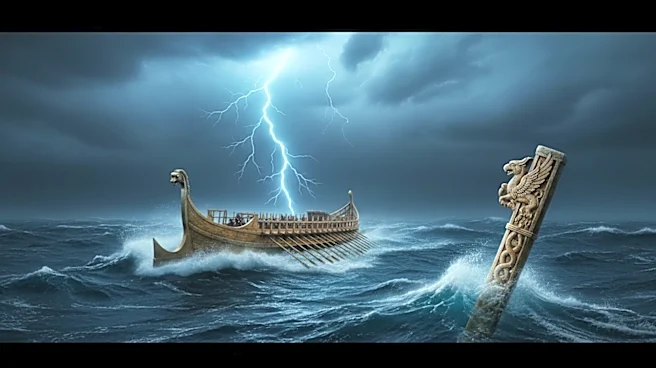
Here’s the problem with 'clever': it’s small. It suggests a knack for puzzles, a slickness, maybe even a slightly dishonest cunning. And while Odysseus is certainly a trickster, that’s only one facet of his character. Reducing him to 'clever' is like calling a decorated, world-weary general 'good at strategy.' You’re not wrong, but you’re missing the point. 'Clever' fails to encompass the suffering and resilience packed into 'polytropos.' The 'turns' are not just ones he actively makes; they are also the turns of fate that are inflicted upon him. He is a man who is turned by the gods, tossed by the seas, and tormented by loss. This passive dimension, this sense of being a survivor of circumstance, is entirely lost in the word 'clever.'
A Hero for Complicated Times
This is why classicist Emily Wilson’s 2017 translation, the first into English by a woman, made waves with its opening line: “Tell me about a complicated man.” 'Complicated,' she argues, captures the spirit of 'polytropos' for a modern reader. The word's Latin root, 'complicare,' means 'folded together,' suggesting a personality with many layers that are hard to unravel. This choice connects Odysseus to the modern anti-heroes we love, from Walter White to Tony Soprano—figures who are brilliant, charismatic, and deeply flawed. They are not simply 'clever'; they are a messy, fascinating bundle of contradictions. 'Polytropos' suggests a man who can be a warrior, a liar, a leader, a loving husband, and a ruthless killer all at once. He is adaptable, able to code-switch between social worlds and even assume different identities to survive.
Losing the Layers
So, what gets lost when we reduce 'polytropos' to 'clever'? We lose the ambiguity. We lose the suffering. We lose the sense of a man shaped by a cruel world, who in turn learns to shape it with his wits. We lose the idea that our hero is defined as much by the hardships he endures as by the schemes he hatches. We lose the connection between the hero's internal state and his external journey—a journey of many turns, undertaken by a man of many turns. The single word 'polytropos' is a character summary, a mission statement for the entire epic, and an invitation to contemplate the messy, multifaceted nature of a survivor. By simplifying it, we aren't just losing a word; we're losing the very essence of the man.