
From Gibson Girls to High Fashion
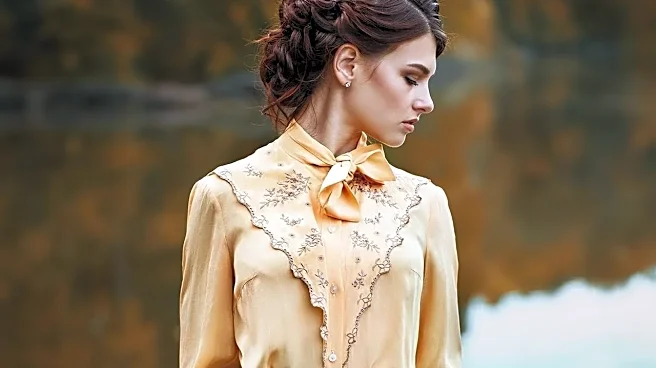
The bow blouse’s story begins not as a statement, but as a practical evolution. Its origins trace back to the lavallière, a form of cravat popular in the 19th century. By the early 20th century, the iconic
Gibson Girl, a symbol of the newly independent and active American woman, adopted a tidy bow at her neck. It was a feminine touch that broke from stuffy Victorian high collars. Later, fashion pioneers like Coco Chanel and Yves Saint Laurent elevated the style. Chanel incorporated it into her vision of modern, comfortable womenswear, while Saint Laurent famously included a dramatic bow blouse in his 1966 “Le Smoking” suit, a revolutionary design that elegantly co-opted the authority of menswear for women.
The 'Dress for Success' Uniform
The blouse’s most defining American moment arrived in the 1970s and 80s, as women entered the corporate workforce in unprecedented numbers. The question of what to wear in these male-dominated spaces was critical. The answer, promoted by authors like John T. Molloy in his influential book "The Woman's Dress for Success," was a uniform that projected authority. The bow blouse became the perfect solution: a direct, feminine equivalent to the man's necktie. Paired with a tailored blazer, often with the era's signature shoulder pads, the bow simultaneously signaled conformity to the professional dress code and a distinctly female presence. It was the sartorial middle ground—neither overtly masculine nor distractingly feminine—that allowed women to be taken seriously.
A Transatlantic Symbol of Power
Across the Atlantic, a powerful contemporary provided a masterclass in the bow blouse’s political utility. British Prime Minister Margaret Thatcher, the “Iron Lady,” made it her signature. She understood that in a world of men in gray suits, her wardrobe was a tool. Thatcher herself said she found the blouses “rather softening,” a way to temper her formidable reputation without ceding an inch of authority. Her tailored suits were her armor, but the soft bow at her neck was a calculated signal of femininity and control, a look that was emulated by professional women and political figures worldwide.
The Modern Political Battlefield
In recent years, the bow blouse has been deployed with more pointed intention. In American politics, it has become a form of silent commentary. Figures like House Speaker Nancy Pelosi have worn them during significant political events, the sharp silhouette of the bow suggesting a kind of decorative armor. Vice President Kamala Harris wore an all-white suit with a bow blouse for her victory speech, a nod to the suffragettes and a symbol of female empowerment. Perhaps most famously, in 2016, Melania Trump wore a hot pink Gucci blouse—with its style name, the "pussy bow," listed on retail sites—to a presidential debate just days after a controversial tape of her husband surfaced. Though the campaign claimed the choice was unintentional, the incident cemented the blouse's status as a garment loaded with potential meaning, capable of sparking a global conversation.