
The Challenge of the Inner World
In a novel, an author has unlimited space to explore a character's thoughts, delve into complex histories, and build entire universes with prose. This is novelistic exposition: the backstory, the world-building,
the internal monologues that give a story its depth and texture. On screen, this becomes a problem. How do you show what a character is thinking without resorting to clunky voice-overs? How do you explain the intricate political alliances of a galaxy far, far away without a text crawl or a lecturer? For decades, Frank Herbert's “Dune” was considered unfilmable for this very reason; its story is steeped in byzantine politics, ecological theory, and religious prophecy. The conventional wisdom has been that film, a medium of action and external reality, simply can't handle the heavy lifting of literary exposition. But is that really true?
From Text Dump to Visual Feast
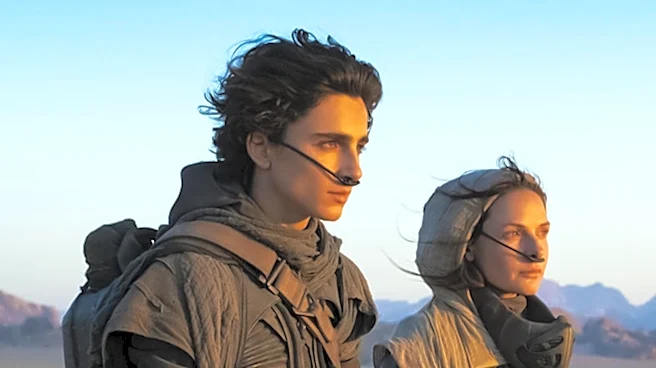
Great directors don’t see exposition as an obstacle; they see it as a creative opportunity. Instead of telling the audience about the world, they immerse them in it. Denis Villeneuve’s adaptation of “Dune” succeeds where others failed partly because it masterfully translates Herbert’s dense lore into staggering visuals. We aren’t just told about the harshness of the planet Arrakis; we feel it in the shimmering heat haze and the oppressive scale of the sand-blasted architecture. Similarly, “Blade Runner 2049” doesn’t need a narrator to explain its dystopian future. The grime, the holographic ads, and the weary faces of its characters tell a richer story than any paragraph could. This is the first rule of adapting exposition: transform information into atmosphere. Let the set design, the costumes, and the cinematography do the heavy lifting.
The Voiceover, Redeemed
Voiceover has a bad reputation, often dismissed as a lazy screenwriter's crutch. But when used with intent and style, it can be a powerful tool for channeling a novel's voice. Martin Scorsese’s “Goodfellas” is a masterclass in this technique. The film is based on Nicholas Pileggi's non-fiction book “Wiseguy,” which is built around the real-life testimony of mobster Henry Hill. Scorsese uses both Henry and his wife Karen as narrators, creating a dynamic, conversational, and deeply personal account of their lives. The narration doesn't just dump information; it provides perspective, irony, and justification, pulling the audience into the characters' worldview. It feels less like exposition and more like a confession shared over a bottle of whiskey, proving that it's not the tool that’s lazy, but how it’s used.
Making an Infodump Entertaining
Sometimes, there's no escaping a complex info-dump. The 2008 financial crisis, for example, is a mess of esoteric instruments like collateralized debt obligations (CDOs). In adapting Michael Lewis's book “The Big Short,” director Adam McKay faced the challenge of making this jargon comprehensible and entertaining. His solution was brilliantly fourth-wall-breaking. The film periodically pauses for celebrities to explain complex financial concepts directly to the audience. We get Margot Robbie in a bubble bath explaining subprime mortgages and chef Anthony Bourdain comparing old fish to CDOs. Ryan Gosling's character uses a Jenga tower to visualize the collapse of the housing market. By turning the exposition into a series of witty, self-aware sketches, the film makes its audience feel smart, not lectured. It's a bold move that embraces the difficulty of the material and turns it into a stylistic signature.