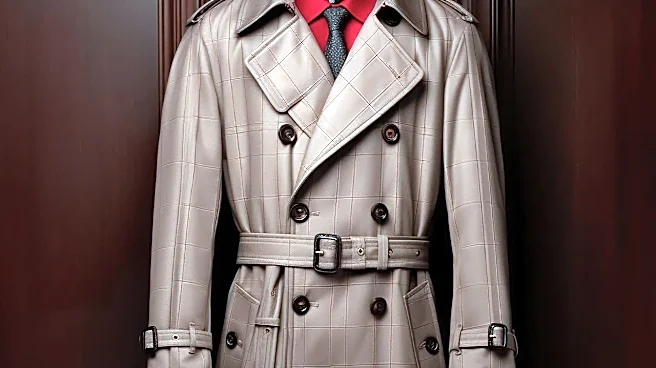







A truly great coat is more than just a purchase; it's a long-term relationship. To make sure you're choosing a partner that will see you through many winters to come, it pays to look beyond the price tag and trend cycle and focus on quality.
1. The Fabric Composition
Always start
with the composition label. Natural fibers are your best bet for longevity and performance. Wool is the workhorse of winter coats, known for its durability, warmth, and ability to hold its shape. A high wool content, ideally 70% or more, is a strong indicator of quality. Cashmere offers incredible softness and warmth for its weight but is more delicate and requires more maintenance. Blends can offer the best of both worlds, with a small percentage of nylon or polyester sometimes added to increase durability without sacrificing the feel of natural fibers. Avoid coats made primarily of acrylic, as they tend to pill and offer poor insulation.
2. The Quality of the Lining
The inside of a coat tells you as much as the outside. A quality coat will be fully lined, which helps it maintain its structure and glide smoothly over your other clothes, like sweaters. Look for linings made from breathable materials like viscose or cupro, which are more comfortable than polyester. Check that the lining is neatly sewn, lies flat without bunching, and has no exposed or messy seams. Some high-end coats even feature a small pleat in the back lining to allow for greater ease of movement. An unlined coat isn't automatically a sign of poor quality, but it should be made from a 'double-faced' fabric, where two layers are bonded together for a clean finish on both sides.
3. The Stitching and Seams
Take a moment to inspect the seams, especially in high-stress areas like the shoulders and armholes. On a well-made garment, the stitching will be straight, dense, and even, with no loose threads or puckering. More stitches per inch equals a stronger seam. If the coat has a pattern, like stripes or checks, see if the pattern lines up at the seams. Mismatched patterns are a telltale sign that the manufacturer was cutting corners to save fabric.
4. The Buttons and Hardware
Flimsy hardware can ruin the impression of an otherwise decent coat. Quality buttons are often made from horn, corozo, or metal, not cheap, shiny plastic. They should feel substantial and be sewn on securely, sometimes with a smaller 'anchor' button on the inside for reinforcement. Zippers should glide smoothly without catching or snagging. Take a close look at the buttonholes, too. They should be neat, dense, and cleanly cut, a small but significant sign of careful craftsmanship.
5. The Cut and Fit
A long term coat should have a timeless silhouette that won’t look dated in a few years. But fit is about more than just style. When you try on a coat, do so wearing a thick sweater or blazer to ensure there's enough room for layering. You should be able to raise your arms and move comfortably without the coat feeling tight across the shoulders or back. Pay attention to the collar; it should lie flat and not gape away from your neck. A quality coat drapes well and doesn't feel stiff or shapeless.
6. The Sleeve Length and Finish
Sleeve length is a crucial but oftenoverlooked detail . The sleeves should be long enough to cover your wrists and keep out the cold , but they shouldn’t swallow your hands . Some high -end coats feature functional button cuffs , but be aware that these can make alterations more complex and expensive . If a coat is perfect in every other way but the sleeves are a bit too long , ask a tailor if they can be easily shortened before you commit .
7 . The Pockets
Well - constructed pockets are a sign of thoughtful design . They should be placed at a comfortable height and be deep enough to be useful . Inspect the interior of the pockets ; are they lined with a sturdy fabric , or does it feel thin and likely to tear ? High - quality coats often have reinforced seams on the pockets to handle the stress of regular use . The presence of functional interior pockets is also a hallmark of a better - made garment .
Finally , step back and look at the coat as a whole . Does it hang evenly ? Does the fabric feel substantial and have a good weight , or is it flimsy ? Pinch the fabric between your fingers ; if it feels dense and springs back , that 's a good sign . A well - made coat has a certain structure and presence that can ’t be faked . It 's built not just to look good on a hanger , but to move with you and stand up to the rigors of daily life for years to come .