








In the dense, brutal world of Panem, every detail matters. Suzanne Collins masterfully weaves threads of history and sorrow through her narrative, and one of the most heartbreaking is a subtle literary reference connecting two generations of District
12 loss.
The Doomed Love of Lenore Dove
Before there was Katniss, there was Haymitch Abernathy. And before his descent into alcoholism and cynical mentorship, there was Lenore Dove. Introduced in the prequel 'Sunrise on the Reaping', Lenore is Haymitch's 16-year-old girlfriend, a member of the musical Covey clan with ties to Lucy Gray Baird. Her name itself is a literary omen, taken directly from the lost love in Edgar Allan Poe's poem, 'The Raven'. Lenore is rebellious and sharp, the emotional anchor for a young Haymitch. Her story ends in tragedy; after Haymitch’s defiant victory in the 50th Hunger Games, President Snow orchestrates her death as part of a cruel punishment. She is killed by a bag of poisoned gumdrops, dying in Haymitch's arms and setting him on a path of lifelong grief.
Haymitch’s Defiant Victory and Terrible Price
Haymitch’s win in the Second Quarter Quell was no ordinary victory. The Games featured double the tributes, making it the deadliest in history. Facing a final opponent from the favored District 1, an injured Haymitch used the arena's force field to his advantage. He dodged her thrown axe, letting it rebound off the invisible wall and strike her down. The Capitol did not see this as clever survival; they saw it as an act of rebellion. Haymitch had used their own weapon against them to make them look foolish. President Snow's retaliation was swift and absolute. Weeks after his return to District 12, not only was Lenore murdered, but Haymitch’s mother and younger brother were also killed in a suspicious house fire. This calculated act of cruelty was designed to break him completely, leaving him with nothing but ghosts and a victor's fortune.
The Symbolism of the Raven
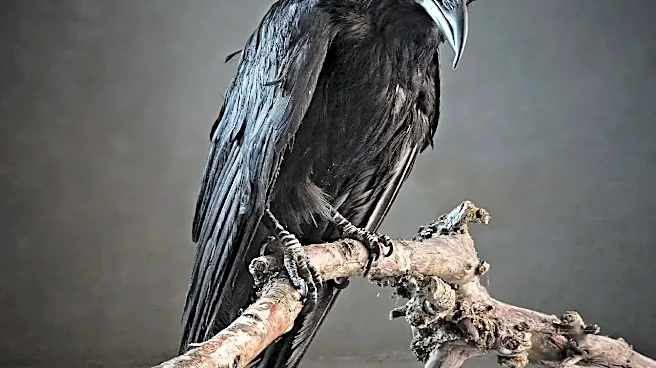
The connection between these two tragedies lies in the symbolism of the raven. In Poe's poem, the raven is an inescapable tormentor, a physical manifestation of 'Mournful and Never-ending Remembrance'. It perches above the narrator, its repeated cry of 'Nevermore' a constant, crushing reminder of his lost Lenore. For Haymitch, Lenore Dove's name directly invokes this very poem, which he had memorized for her. The story becomes his reality; he is the haunted narrator, and she is the love who is gone forever. Poe's raven symbolizes the finality of death and the persistence of grief, a shadow from which the soul 'shall be lifted—nevermore'. This literary parallel transforms Haymitch's backstory from a simple tragedy into a living poem of inescapable sorrow.
An Echo of Cruelty Across Generations
The raven connection deepens when you consider the Capitol's history of cruelty. In 'The Ballad of Songbirds & Snakes', which takes place 40 years before Haymitch's games, Dr. Gaul conducts horrific experiments with weaponized birds, including jabberjays and ravens. These experiments show the Capitol’s longstanding fascination with using birds as instruments of psychological torture. While the books state Haymitch's family died in a fire and Lenore by poison, the symbolic link established by her name is undeniable. The raven represents a specific type of Capitol punishment rooted in psychological torment, tying Haymitch's personal grief to the foundational cruelty of Panem. The raven that haunts Poe's narrator becomes the metaphorical embodiment of President Snow's power—a constant, dark presence ensuring Haymitch never forgets who holds ultimate control.