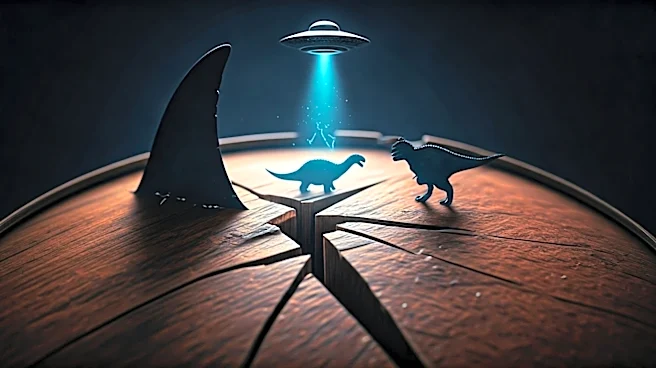










The Real Spielberg Signature
For all the awe and wonder, Spielberg's true signature isn't the monster or the spaceship; it's the fractured American family. More often than not, his most iconic films aren't just about surviving an extraordinary event, but about how that event tests,
breaks, or ultimately rebuilds a fragile family unit. His protagonists are often grappling with divorce, emotional distance, or profound paternal anxiety long before the T-Rex breaks through the fence. The spectacle is the catalyst, but the emotional core is almost always the messy, complicated, and deeply relatable drama happening at the dinner table—or in the panicked jeep, or on the sinking boat.
Jaws: The Father Who Can't Protect
On the surface, *Jaws* is a simple monster movie. But its emotional anchor is Police Chief Martin Brody (Roy Scheider), a man who moved his family from the chaos of New York City to the quiet shores of Amity Island seeking safety. The shark represents the ultimate violation of that promise. Every attack is a personal failure for Brody as a protector. His terror isn't just about being eaten; it's the primal fear of a father unable to keep his children safe in their own front yard. His journey out to sea with Quint and Hooper isn't just a hunt—it's a desperate pilgrimage to reclaim his authority as a patriarch. When he finally kills the shark and laugh-cries with Hooper, it’s the relief of a man who can finally go home and prove to his family, and himself, that he can still keep the monsters at bay.
UFOs: The Families Healed and Broken
Spielberg’s UFOs present two sides of the same coin. In *Close Encounters of the Third Kind*, Roy Neary’s (Richard Dreyfuss) obsession with the alien visitors literally destroys his family. His wife, unable to comprehend his manic quest, takes the children and leaves. The film powerfully depicts the loneliness of a man whose cosmic calling alienates him from everyone he loves. He ultimately abandons his terrestrial family to join a new, celestial one. It’s a bittersweet, almost tragic ending for the suburban dad. Five years later, *E.T. the Extra-Terrestrial* flips the script. Here, the fractured family—a single mother and three kids reeling from a recent separation—is healed by the alien. E.T. fills the father-shaped hole in Elliott’s life, and the shared secret of protecting him forges an unbreakable bond between the siblings and, eventually, their mother. The alien doesn’t break the family; it puts it back together.
Jurassic Park: The Reluctant Dad
Nowhere is this theme more explicit than in *Jurassic Park*. Paleontologist Alan Grant (Sam Neill) famously, comically dislikes children. “They’re noisy, they’re messy, they’re expensive,” he grumbles, terrifying a kid at a dig site. The universe, in the form of a dinosaur-filled theme park gone haywire, immediately calls his bluff. The plot conspires to strand him with John Hammond’s grandchildren, Lex and Tim, forcing him into the role of a reluctant surrogate father. His entire character arc is a journey from curmudgeonly academic to fierce protector. He learns to care for them, shield them from velociraptors, and guide them to safety. The film’s quiet, poignant final shot isn’t of a dinosaur; it’s of Grant, with the sleeping children nestled against him, looking out at the horizon next to Ellie Sattler. He found a family, whether he wanted one or not.