

The Five-Lane Highway
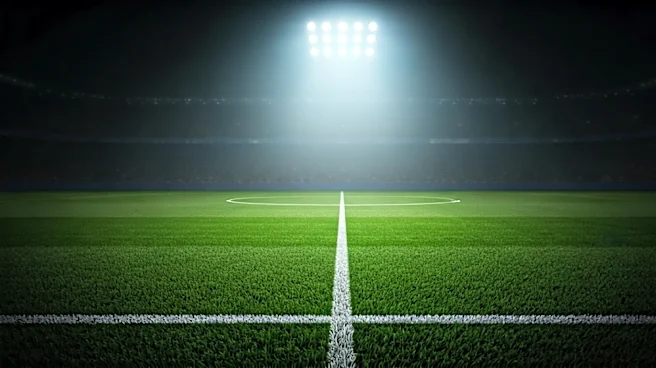
Imagine a soccer field isn't just one big green rectangle, but a highway divided into five vertical lanes running from goal to goal. You have the two wide lanes along the sidelines (the flanks), one lane right down the middle (the center), and then the two lanes in between. Those two in-between lanes are the half-spaces. They are the vertical channels that sit between the wide players and the central players. Think of them as the zone where a winger might drift inside or a central midfielder might drift wide. It’s not the wing, and it’s not the dead-center of the field. It’s this hybrid, in-between zone that has become the most valuable and hotly contested piece of real estate in modern soccer.
A Defender's Worst Nightmare
So, why is this specific channel so important? Because
it creates chaos and indecision for defenders. When an attacking player receives the ball in the half-space, they pose an immediate, complex threat. Who is supposed to mark them? Is it the fullback’s job to come inside, leaving the wide area exposed? Or should a center-back step out, leaving a gap in the heart of the defense for a striker to run into? This moment of hesitation is exactly what attackers want. Furthermore, a player in the half-space has a panoramic view of the field. They are facing the goal, not stuck on a sideline, and have diagonal passing options that can split the defense apart. They can shoot, pass wide, cross, or play a ball through the middle. For a defender, it’s a 'pick your poison' scenario where every option feels wrong.
The Pep Guardiola Obsession
While smart players have intuitively drifted into these areas for decades, the modern tactical obsession with the half-space can largely be credited to coaches like Pep Guardiola. His teams at Barcelona, Bayern Munich, and Manchester City are built around a simple principle: get your most creative players the ball in the half-space, with time and space to turn. His training sessions are famous for meticulously drilling patterns of play designed to move the ball from one area of the field to overload another, creating an opening for a player to pop up in that exact zone. It's the tactical equivalent of a quarterback executing a perfect play-action fake to get a receiver wide open down the seam. For Guardiola, the half-space isn't just a place; it's the destination that his entire team's possession game is designed to reach.
The Modern Masters of the Craft
Once you know what to look for, you’ll see the best players in the world living in the half-spaces. Manchester City’s Kevin De Bruyne is perhaps the ultimate example. His signature move is receiving the ball in the right half-space and whipping a devastating, curling cross toward the back post that seems to bend the laws of physics. Arsenal’s captain, Martin Ødegaard, operates almost exclusively in these pockets of space, dictating his team’s entire attacking rhythm from there. Look at Lionel Messi’s career 'heat maps'—the areas where he touches the ball most—and you'll see a bright red concentration in the right half-space, just outside the penalty box. It's from this position that he can either cut in to shoot with his legendary left foot or slip a pass through to a teammate. These players aren't just great athletes; they are masters of geometry and space, and the half-space is their canvas.