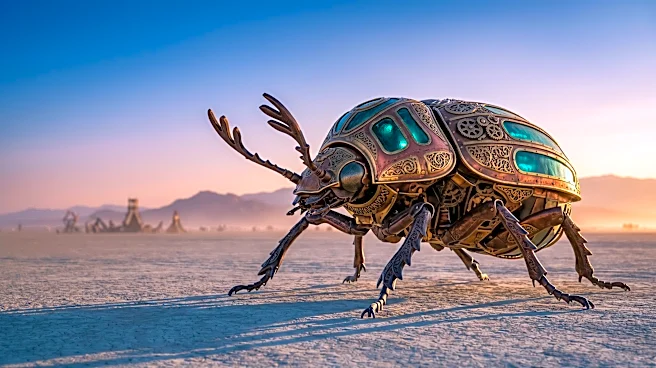








It's About Mutation, Not Decoration
The absolute number one rule from Burning Man's own Department of Mutant Vehicles (DMV) is that a vehicle must be 'radically mutated.' This isn't about throwing some fairy lights on a pickup truck or attaching a few festive items. The goal is to transform
the base vehicle so completely that it bears little to no resemblance to its original form. Think of it this way: if you can still immediately identify it as a Ford F-150 or a golf cart, it’s not a Mutant Vehicle; it's what veterans call a “decorated truck” or, less kindly, a “sparkle pony.” The mutation should be so profound that the original chassis is just a forgotten skeleton, with a completely new creation—be it a dragon, a spaceship, or a deep-sea anglerfish—built on top of it. Stripping a vehicle down to its frame also doesn't count. It’s about the addition of art, not just the subtraction of the mundane.
The Vehicle Must Offer an Experience
A true Mutant Vehicle is not just for private transportation; it's a gift to the community. According to the official criteria, a key element is interactivity. This means the vehicle should offer something to other participants. Often, this takes the form of giving rides, turning the vehicle into a mobile stage for DJs, or creating a lounge space for people to gather. Some of the most beloved vehicles are essentially rolling art installations that invite participation, like one that functioned as a mobile art jam session where anyone could paint. The purpose is to create delight and add to the communal experience, not just to get the owner from one side of the playa to the other. If it functions solely as a personal taxi, it misses the point entirely.
Lighting Is an Art Form, Not an Afterthought
Come nightfall, the desert transforms into a sea of light, and Mutant Vehicles are the main event. But there's a huge difference between safety lighting and artistic illumination. The DMV requires vehicles licensed for night driving to be 'radically illuminated.' This goes beyond simply ensuring the vehicle is visible. Every extremity must be lit for safety, including stairs, railings, and hitches. But a great Mutant Vehicle integrates its lighting into the theme. The lights don't just sit on the vehicle; they are part of its identity, accentuating its form and enhancing its story. Think of a giant octopus whose tentacles don't just have lights on them, but whose lights pulse and change color with the music it plays. This thoughtful execution is what separates a breathtaking mobile sculpture from a truck with Christmas lights taped to it.
It's Built to Survive the Playa
The Black Rock Desert is an unforgiving environment. The fine, alkaline dust gets into everything, and the temperature swings can be extreme. A well-built Mutant Vehicle is 'playa-proofed.' This means the construction is robust, with no loose parts that could fall off and become MOOP (Matter Out of Place), which is a major violation of Burning Man's 'Leave No Trace' principle. Safety is paramount, with requirements for sturdy railings, no sharp edges, and good brakes capable of maintaining the strict 5 MPH speed limit. If a vehicle incorporates flame effects—a popular feature—it must undergo an even more rigorous inspection to ensure fuel lines are protected, tanks are secure, and flames shoot at least 10 feet above any area where a person could stand. A flimsy, poorly constructed vehicle won't get a license and, even if it did, it likely wouldn't survive the week.
It Has a Cohesive Vision
The most memorable Mutant Vehicles are more than just a collection of weird parts; they have a cohesive theme and a clear artistic vision. Whether it's a massive, steampunk-inspired sailing ship that appears to float across the sand or a fire-breathing dragon made of scrap metal, the best designs tell a story. This vision extends to every detail, from the overall structure down to the sound design and crew costumes. This is the 'wow factor' the DMV is looking for. It demonstrates a level of commitment and artistry that goes far beyond simple decoration. The vehicle becomes a singular, unified piece of mobile art. Builders often spend months, or even years, and tens of thousands of dollars to bring these complex creations to life, driven by passion rather than practicality.