






The 4-4-2: The '12 Personnel' of Soccer
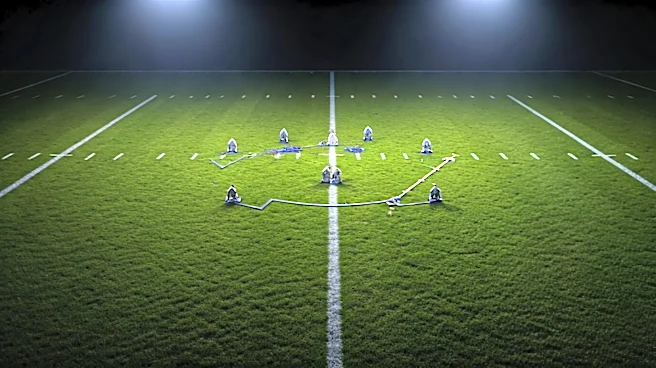
The 4-4-2 (four defenders, four midfielders, two forwards) is the classic, balanced formation. Think of it like a football team running '12 personnel' (1 running back, 2 tight ends, 2 wide receivers). It's not flashy, but it’s fundamentally sound and
gives the coach options. The two tight ends in '12 personnel' can block on a run play or go out for a pass. Similarly, the four midfielders in a 4-4-2 provide a solid defensive block but can also support the attack. It’s a formation built on partnership: two central defenders, two central midfielders, two forwards. Like a classic I-formation running game, it can feel a bit predictable or outdated against more dynamic schemes, but its strength is its simplicity and defensive solidity. When you see a team in a 4-4-2, they’re not trying to trick you. They’re lining up, saying, “We’re solid everywhere. Come and beat us.” It's the meat-and-potatoes of soccer tactics.
The 4-3-3: The '11 Personnel' Spread Attack
If the 4-4-2 is '12 personnel,' the 4-3-3 is modern football’s favorite package: '11 personnel' (1 running back, 1 tight end, 3 wide receivers). This is the default attacking formation of the modern era. By sacrificing a midfielder for an extra forward, a team in a 4-3-3 is declaring its intent to score. It’s about stretching the defense wide and creating one-on-one matchups, just as a three-receiver set does in football. The three forwards (typically a central striker and two wingers) pin the defense back, creating space for the three midfielders to control the game. The lone central striker is like the primary 'X' receiver, while the wingers are the speedy slot guys creating havoc. A team using a 4-3-3 is confident in its athletic ability and wants to dictate the tempo. It can be vulnerable to a counter-attack if the midfielders push too far forward, just as a pass-heavy offense can be susceptible to a sack or interception if the line doesn't hold.
The 3-5-2 / 5-3-2: The 'Jumbo' or 'Dime' Package
This formation is all about tactical flexibility and creating a numbers mismatch in a specific area of the field. A 3-5-2 (three defenders, five midfielders, two forwards) can look very different depending on the situation. Think of it like a football team’s situational personnel group. When attacking, it’s a 'Jumbo' package, flooding the middle of the field with bodies (the five midfielders) to overwhelm the opponent and control possession before feeding the two forwards. The two 'wing-backs' are the key; they have to cover the entire length of the field. When defending, those same wing-backs drop back, and the formation instantly becomes a 5-3-2. This is the soccer equivalent of a 'Dime' defense, bringing in extra defensive backs to protect against the pass. It sacrifices a traditional wide threat for central solidity and defensive security. A team using this formation is often looking to absorb pressure and hit on the counter-attack, like a defense creating a turnover and scoring.
The 4-2-3-1: The Modern, Complex Pro-Style Offense
The 4-2-3-1 is arguably the most popular and sophisticated formation in top-level soccer today. It’s the tactical equivalent of a complex, pro-style offense in football with motion, shifts, and multiple reads. The key is the 'double pivot'—the two defensive midfielders sitting in front of the back four. They are the offensive linemen of soccer, providing the protection that allows the four attacking players ahead of them to create. The three attacking midfielders are interchangeable threats, much like a versatile receiving corps. One might be a speedy deep threat, one a possession receiver, and the central one—the 'Number 10'—is the quarterback of the attack, operating in the pocket of space behind the main striker. This formation offers the defensive stability of having two dedicated holding players, combined with the attacking flexibility of four players who can interchange positions. It requires highly intelligent players, but when it works, it’s a perfectly balanced machine.