


The Classic Alien Companion
For decades, the alien sidekick has been a beloved, if somewhat limited, trope. Think of Chewbacca, the ultimate space pal. He’s strong, incredibly loyal, and communicates in growls that only his closest friend can understand. Or consider Groot, who is both
a powerful protector and, in his younger form, an adorable dependent. They are characters defined by their relationship to the human (or human-like) protagonist. They are indispensable but rarely equals. Their motivations, inner lives, and intellectual contributions often remain secondary to their primary role as a companion. They are the galaxy’s best wingmen, bodyguards, and occasionally, living weapons. We love them for their unwavering loyalty and the unique flavor they bring, but they are almost always defined by their service to the hero's journey.
Enter Rocky: A Partner, Not a Pet
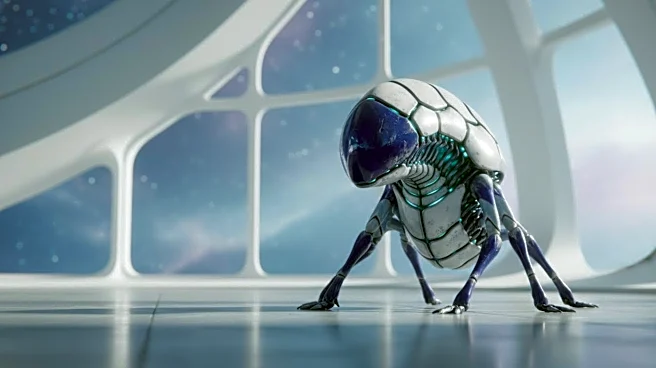
Then came Rocky. When protagonist Ryland Grace, an amnesiac astronaut on a mission to save Earth, first encounters the alien from the 40 Eridani system, the dynamic is immediately different. Rocky is not a subordinate waiting for orders. He is the sole survivor of his own desperate mission to save his own planet, Erid. Physically, he’s a spider-like creature of rock and metal, and he communicates through musical chords. More importantly, he's an engineer—a brilliant one. Unlike sidekicks who are primarily defined by their loyalty or physical prowess, Rocky is defined by his intellect. The story doesn't position him as Grace’s helper; it establishes him as Grace’s scientific peer. They are two specialists, stranded at the edge of the solar system, who just happen to be from different worlds.
The Universal Language of Science
The masterstroke of Project Hail Mary is how it builds their relationship. The foundation of their bond isn't emotion or a shared battle against a common enemy, but a shared understanding of physics. Their first “conversations” are about math and chemistry. They use the universal laws of science to bridge the immense gap between their species. This reimagines the very basis of interspecies collaboration. Grace doesn't just learn to understand Rocky's musical language; he learns to think with him. They solve problems together, with each providing knowledge the other lacks. The novel is filled with exhilarating scenes of them geeking out over astrophage, xenonite, and engineering challenges. Their teamwork isn't about one hero leading and the other following; it's a partnership of minds working to solve an existential threat that affects them both.
A Friendship Forged in Discovery
This intellectual equality allows for a much deeper and more moving friendship to develop. Because Rocky is a fully realized character with his own agency, stakes, and fears, his choices carry immense weight. He isn't just there to save Grace; he has his own world and civilization to worry about. This culminates in a powerful dilemma where the mission's cold, utilitarian logic clashes with their personal bond. In one of the story's most pivotal moments, Rocky makes a choice that prioritizes his friendship with Grace over the most efficient path to saving his own species, demonstrating a capacity for loyalty that feels earned, not programmed. By the end of the novel, Grace makes a similar sacrificial choice, cementing their relationship as one of true equals who have fundamentally changed one another. Rocky isn’t just a great alien character; he’s one of the best friendship portrayals in modern science fiction.