








The Anatomy of a Threat
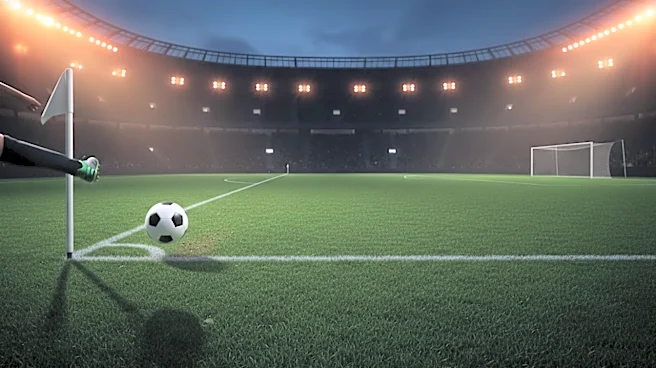
On the surface, a corner kick seems like a low-percentage play. The ball is launched into a crowded penalty box, a chaotic forest of bodies where defenders theoretically have every advantage. Statistics often show that only a small fraction of corners
lead directly to a goal. Yet, every team at the elite level now has at least one coach dedicated entirely to set pieces. Why? Because in a game of fine margins, the corner kick is a weapon of immense potential. It’s a unique moment where an attacking team can pre-plan a specific routine, placing their best headers of the ball against potentially weaker defenders. It’s a manufactured mismatch. Unlike the fluid chaos of open play, a corner allows an attack to be rehearsed and deployed with precision, turning a statistical improbability into a very real, targeted threat that can bypass a defense that has been otherwise unbreakable for 90 minutes.
The Tactical Chess Match
When a corner is awarded, a frantic, unspoken chess match begins. The defending team must decide its strategy: zonal marking, where players defend specific areas, or man-to-man marking, where each player is assigned an opponent. Most teams today use a hybrid of the two. The goalkeeper shouts instructions, organizing the defensive wall at the near post while trying to find a clear line to punch the ball away. Their positioning is critical; a step too far forward leaves the goal open, a step too far back invites a flick-on. Meanwhile, the attacking team is running its own plays. Attackers use screens and blocks—basketball-style moves now common in soccer—to free up their primary aerial threat. They might crowd the goalkeeper to disrupt their movement or send a decoy runner to the near post to drag defenders out of position, all to create a sliver of space for the real target arriving at the back post. The kick-taker has their own choices: an inswinger that curls toward the goal, making it difficult for the keeper, or an outswinger that moves away, inviting a running header.
The Ghosts of Tournaments Past
History is littered with champions crowned and giants slain by this single play. Think of the 2014 Champions League Final. Atlético Madrid were seconds from a historic title when Real Madrid’s Sergio Ramos rose to meet a 93rd-minute corner, his header forcing extra time and ultimately breaking Atlético’s spirit. The entire trajectory of European soccer history was altered in that moment. In the World Cup, the stakes are even higher. Just this tournament, in 2026, four-time winner Germany was sent crashing out by Paraguay in the Round of 32. The Germans thought they had a late winner from a corner, only for it to be controversially disallowed, a moment that highlighted the fine line between triumph and disaster. In 2018, defending champion Germany was eliminated in the group stage when South Korea’s Kim Young-Gwon scored from a corner deep in stoppage time. These moments become etched in national memory—proof that in a knockout game, you are only ever one corner kick away from ecstasy or despair.
The Psychology of the Six-Yard Box
More than tactics, the late-game corner is a battle of nerve and concentration. For the favored team, which has likely dominated possession and created numerous chances, the corner is a moment of extreme vulnerability. After controlling a match for what feels like an eternity, their fate can be decided by a single lapse, a missed assignment, or a lucky bounce. The pressure to maintain perfect organization against this one sudden threat is immense. For the underdog, it’s the opposite. It’s a golden ticket. They’ve weathered the storm, defended with their lives, and now they have a free, uncontested chance to deliver a ball into the most dangerous area on the field. It’s a moment of pure hope, a low-risk, high-reward opportunity to land a knockout punch against a superior opponent. This psychological asymmetry is what makes the corner kick so compelling. It’s where a year of planning can be undone, and where a fairytale can begin.