



The Revolutionary Bias-Cut Gown
This is Vionnet’s signature innovation and the holy grail for any collector. Before her, fabric was cut along its rigid straight grain. Vionnet turned it 45 degrees, cutting on the bias to unlock its natural elasticity. The result was a garment that draped
and clung like a second skin, moving with the body rather than restricting it. These gowns, often in silk crêpe or satin, feel impossibly modern, pouring over the wearer’s curves with a liquid grace that rejected the stiff, structured clothing of the era. Hunting for an authentic bias-cut Vionnet means looking for masterful, often minimal, seam work and a silhouette that seems to defy construction.
A Grecian-Inspired Draped Dress
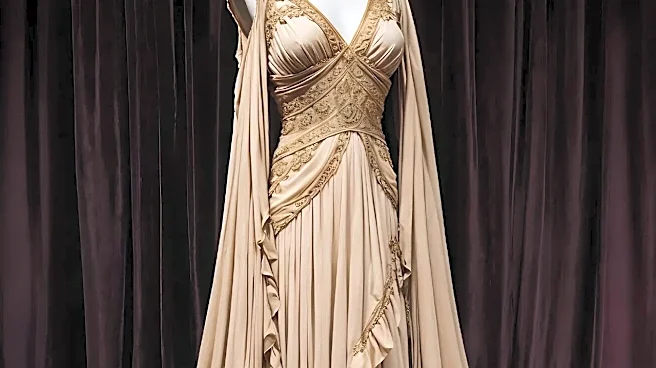
Vionnet was famously inspired by ancient Greek statues, and this influence is clear in her classically draped designs. She sought to liberate the body, and her Grecian gowns were a direct challenge to the corsetry of the time. These pieces often appear deceptively simple, relying on the strategic draping of a single piece of fabric or a few cleverly joined panels to create a timeless, columnar silhouette. Look for designs with cowl necks, halter tops, or intricate folds that seem to melt into the dress itself. Owning one is like owning a piece of wearable sculpture, a testament to her belief that a dress should honor the natural female form.
The Geometric 'Handkerchief' Dress
Showcasing her genius for geometric construction, Vionnet’s handkerchief dresses are a marvel of engineering. Typically made from squares or rectangles of fabric, these designs feature pointed hemlines that create a fluttering, dynamic movement when the wearer walks. She transformed simple two-dimensional shapes into complex three-dimensional garments that were both playful and elegant. A vintage find might feature a skirt made of just three or four large squares, with the bodice and panels cut from a single piece of fabric. It's a prime example of her Cubist-inspired creativity and her ability to make complex patterns look effortless.
Anything with a Halter or Cowl Neckline
While she didn't invent them from scratch, Vionnet perfected and popularized both the halter top and the cowl neckline, making them signatures of her aesthetic. These features were often born directly from her bias-cut technique. The cowl neckline emerged naturally from the way bias-cut fabric would drape, creating soft, sculptural folds around the clavicle without complex stitching. The halter neck offered a new, daring way to expose the back and shoulders, fitting perfectly with her philosophy of celebrating the body. Finding a Vionnet dress with one of these necklines is finding a piece that embodies her innovative approach to creating sensuous, modern silhouettes.
A Piece with Exquisite Decorative Seaming
For Vionnet, construction was decoration. While other designers might add beads or embroidery, Vionnet often used the seams themselves as an ornamental feature. She pioneered visible seaming techniques like faggoting (a delicate, ladder-like stitch connecting two fabric edges) and pin-tucking to create intricate surface details. On some garments, her seams form elaborate star or flower shapes, turning a structural necessity into a beautiful focal point. A true Vionnet piece showcases this impeccable craftsmanship, where every stitch serves both a functional and an aesthetic purpose. It’s a subtle detail that speaks volumes about her architectural approach to fashion.
A Garment with Her Fingerprinted Label
Plagiarism was rampant in the 1920s and 30s, and Vionnet, a shrewd businesswoman, was one of the first designers to actively fight against copyists. To authenticate her work and protect her innovations, she introduced a unique labeling system. Each original couture piece bore a label that included her signature and an imprint of her right thumb. Finding a vintage piece with this fingerprinted label is the ultimate mark of authenticity. It’s not just a dress; it’s a verified work of art from one of fashion’s most important revolutionaries, a woman who valued her intellectual property as much as her creative vision.