




The Primal Power of Fire
Long before LED panels could simulate a flame, Burning Man artists were mastering the real thing. Fire is in the event's DNA, dating back to the first wooden Man burned on Baker Beach in 1986. But beyond simply burning the art at the end of the week,
builders learned to sculpt with flame itself. Using pressurized propane and accumulator tanks, artists create stunning flame effects often called “poofers.” These aren't just crude flamethrowers; they are precisely controlled bursts of fire that can be synchronized to music or triggered by participants. Works like Kasia Wojnarksi's flaming geometric sculptures allowed people to walk within safely contained walls of fire, creating an experience of contained danger and warmth that a screen can't replicate. This elemental art form remains a powerful crowd-drawer because it's visceral; you feel the heat and hear the roar, connecting you to the art in a primal way.
The Theater of Giant Puppets
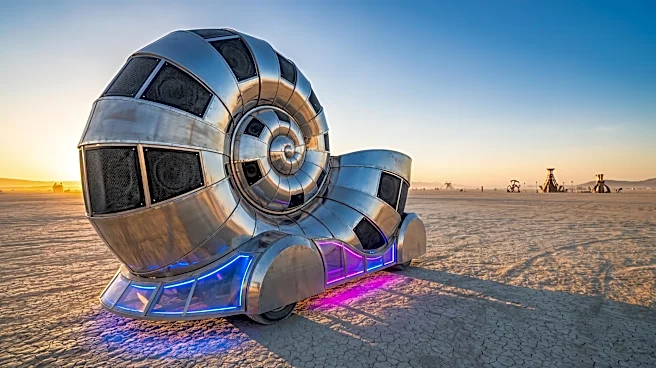
Imagine a 20-foot-tall marionette taking slow, deliberate steps through a crowd of thousands, its movements not powered by robotics but by a team of puppeteers and a crane. This is the magic of large-scale mechanical puppetry, a long-standing tradition on the playa. Artists like Miguel Angel Martin Bordera have brought enormous, moving figures to life, creating a sense of storybook wonder. Similarly, art cars are often much more than just decorated vehicles. They are rolling, kinetic sculptures. Jon Sarriugarte and Kyrsten Mate’s Golden Mean, a giant snail car, was inspired by the mechanical puppets of Royal de Luxe. These creations rely on clever engineering, hydraulics, and often, direct human power to achieve their mesmerizing motion. They don't just move; they perform, turning the open desert into a stage for giants.
The Illusion of Stroboscopic Zoetropes
One of the most mind-bending analog tricks is the zoetrope, a 19th-century invention that creates the illusion of animation. Artist Peter Hudson has become a master of the form at Burning Man, creating massive, human-powered stroboscopic zoetropes. His piece, "Charon," unveiled in 2011, featured 20 skeleton figures mounted on a 30-foot wheel. To make it work, a team of at least 12 people had to physically spin the massive structure. As it rotates, strobe lights flash at a precise frequency, animating the individual sculptures into a seamless, ghostly motion, telling the story of the mythological ferryman of the underworld. The effect is often described as a mass hallucination, a flickering, live-action animation that feels impossible. It’s a trick of persistence of vision, proving that a bit of physics can be just as magical as a million pixels.
The Simplicity of Shadow and Light
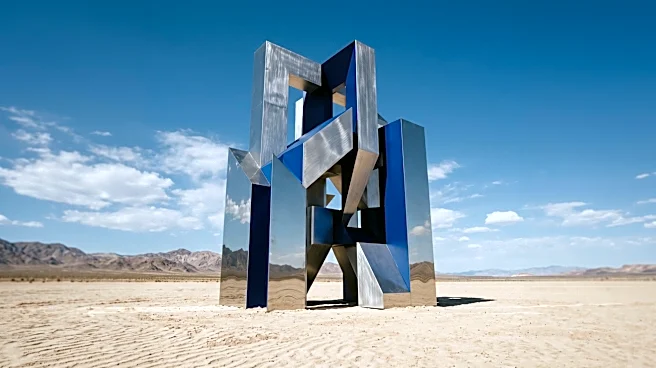
Before complex projection mapping, artists used the simple interplay of light and shadow to transform the desert landscape. By placing a single powerful light source behind a sculpture with intricate cutouts or moving parts, artists could cast enormous, dancing shadows across the playa floor or onto a nearby screen of fabric. This low-tech approach creates a dramatic, high-contrast visual that draws viewers in. Other builders use mirrors and reflective surfaces not just for decoration, but to multiply light sources and create dazzling, disorienting patterns that shift as you walk past. It’s an optical illusion at an architectural scale, a reminder that the most profound effects sometimes come from the simplest tools: a light, an object, and the shadow it leaves behind.
The Genius of Mechanical Transformation
Some of the most wondrous playa art doesn't rely on light at all, but on pure mechanics. Inspired by origami, the FoldHaus collective created "Blumen Lumen," a garden of massive flowers whose petals would open and close. The movement was powered by linear actuators, turning sheets of folded plastic into a field of breathing organisms. Another artist, Henry Chang, scaled up the inner workings of a pocket watch to create a massive, three-axis tourbillon, a mesmerizing mechanical device designed to counteract gravity, and mounted it on an art car. These pieces celebrate the beauty of engineering itself. The wonder comes from watching a complex machine move with grace and purpose, revealing the intricate thought and craftsmanship that went into its design. It’s a type of magic rooted in gears, levers, and the elegant solving of physical problems.