






1. Pre-Curved Arms and Legs
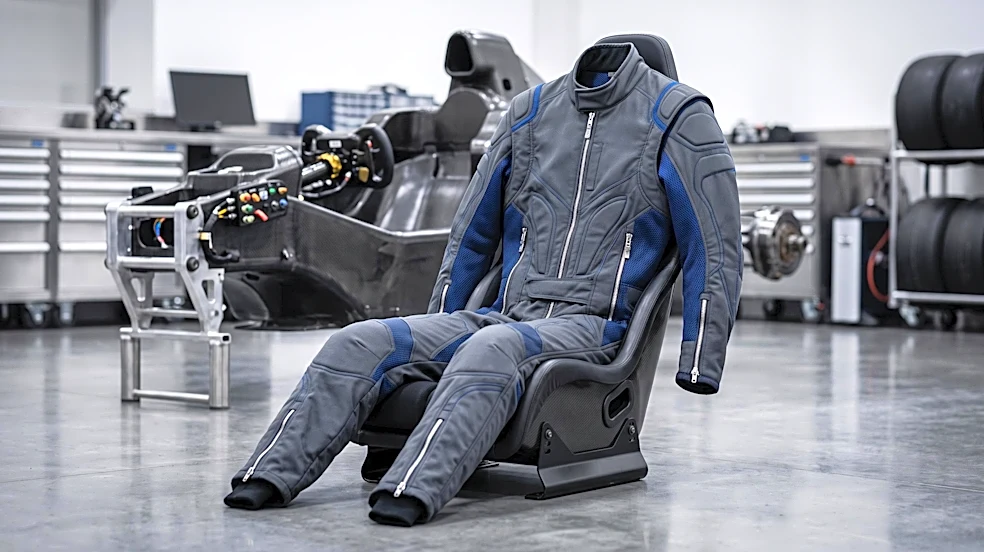
Look closely at a race suit on a hanger, and you'll notice the limbs aren't straight. They have a distinct, permanent bend. This 'pre-curved' design mimics a driver’s natural posture in a cockpit, with arms bent to hold the steering wheel and legs angled
to work the pedals. This simple but crucial feature prevents the fire-retardant fabric from bunching up at the elbows and knees. Less bunching means more comfort, better blood flow, and less physical distraction during a long and grueling race.
2. Fully Floating Sleeves
When a driver steers, their arms need to move freely without the entire torso of the suit pulling and twisting. The solution is the 'fully floating' sleeve. This feature uses a 360-degree stretchable gusset, typically made of a flexible knit fabric, to connect the sleeve to the shoulder. Think of it like the flexible joint on an accordion. This allows a full range of arm and shoulder movement, completely independent of the suit's body. It’s essential for quick, precise steering corrections without fighting the garment.
3. Anatomical Stretch Panels
A race suit is designed to fit snugly for safety, but it can't be restrictive. To solve this, designers place large elasticated stretch panels in key areas. The most important one is typically on the lower back, which allows the driver to stretch and lean forward without the suit pulling down from their shoulders or riding up from their legs. You'll also find smaller stretch panels behind the knees, at the crotch, and sometimes around the elbows to enhance flexibility exactly where the body articulates most.
4. Asymmetrical Torso Pattern
If you were to lay a racing suit flat, you'd find the pattern for the torso is not symmetrical from front to back. The back panel is often cut longer than the front. When a driver is strapped tightly into a bucket seat, this design ensures full coverage over their lower back while preventing a heap of extra fabric from bunching up over their stomach and lap belts. It’s a subtle adjustment that makes a huge difference in comfort and eliminates pressure points from the safety harness.
5. Rotated Sleeve Positioning
It’s not just that the arms are pre-bent; their entire attachment point is rotated forward. A standard jacket has sleeves set to hang naturally at a person's sides while standing. A race suit, however, sets the sleeves at a forward angle, matching the position where a driver’s arms extend toward the steering wheel. This ergonomic detail means there’s no tension or pulling across the driver's back and shoulders, reducing muscle fatigue over hundreds of laps.
6. A Lowered, Softer Collar
In a race car, a driver’s head is pushed forward by the seat, helmet, and a head-and-neck restraint device. A standard collar would dig into the chin and throat, becoming a constant, irritating distraction. Because of this, many modern suits feature a lower-profile or softer-edged collar. This provides the necessary fire protection around the neck without chafing or restricting head movement, allowing the driver to scan mirrors and look toward the apex of a corner comfortably.
7. Slim, Unobstructed Leg Fit
The cockpit of a race car, especially an open-wheel formula car, is incredibly tight. Any excess material can snag on pedals, wiring, or other components. Race suit legs are cut to be slim and functional. Options like 'boot cut' styles, where the leg goes over the shoe, are often avoided in single-seaters in favor of a traditional elasticated cuff that tucks securely into the racing boot. This ensures a clean interface with the pedals and prevents any interference during critical footwork.