






The High-Waist: Engineered Elegance
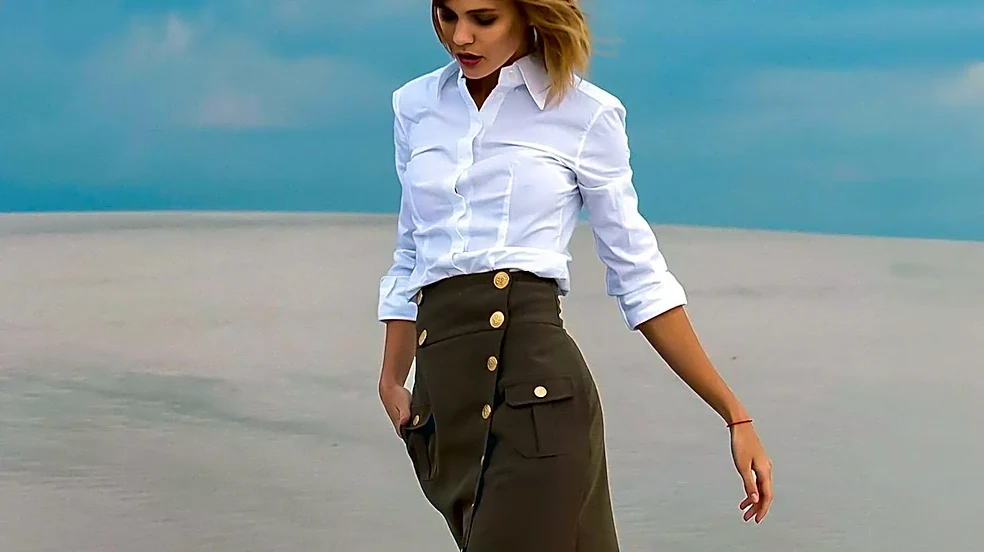
When you pull a skirt up to the natural waist or higher, you’re doing more than just following a trend. You are fundamentally changing the garment's center of gravity and pivot point. A high-waisted skirt anchors itself at the narrowest part of the torso.
This has two major effects. First, it creates a long, unbroken line from the waist down, making your legs appear longer. Second, by securing the skirt above the hips, it restricts the fabric's movement at the top. This means that when you walk, the motion doesn't come from your hips swaying the fabric directly. Instead, the energy travels down the garment, creating a more dramatic, pendulum-like swing at the hem. Think of a classic A-line or circle skirt; its satisfying swoosh is a direct result of the stability provided by its high anchor point. A high-waisted cut almost acts like a gentle shaping garment, providing structure and a secure fit that prevents the annoying twisting or rotating that can happen with lower-slung styles.
The Low-Rise: A Fluid, Hip-Driven Motion
Dropping the waistband to sit on the hips—the signature of a low-rise skirt—radically alters the physics of its movement. Instead of being anchored to a stable point on the torso, the skirt now moves directly with the motion of your hips. Every step you take causes the fabric to shift and glide. This creates a more fluid, slinky, and relaxed drape that closely follows the body's natural movement. The visual effect is a lengthened torso and an emphasized hip line. Because the pivot point is lower, the skirt has less distance to travel before it ends, resulting in a subtler, more contained swing compared to its high-waisted counterpart. The movement becomes less about a grand, sweeping gesture and more about a liquid ripple that originates from the wearer's gait. This is why fabrics with a good drape, like satin or light cottons, work so well with low-rise cuts; they are designed to echo the body’s motion, not create their own.
The Drop-Waist: A Study in Contrasts
The drop-waist is perhaps the most interesting case study in how placement engineers movement. Here, the skirt's bodice is elongated, extending past the natural waist to the high hip before flaring out. This creates a unique two-part silhouette. The top portion is fitted and structured, lengthening the torso like a column. Then, from its low seam, the skirt erupts into pleats, ruffles, or a fuller shape. The movement is therefore delayed and concentrated at the bottom. It doesn’t swing from the waist or sway with the hips; it kicks and flounces from a line set across the hip bones. This silhouette, famous from the 1920s flapper era, creates a striking contrast between a sleek, elongated upper body and a burst of kinetic energy below. The modern drop-waist plays with this tension, pairing a clean, tailored bodice with a skirt that feels soft and full of motion.
It’s Not Just Placement—Fabric Is Key
Of course, waist placement is only one part of the equation. The fabric itself is its partner in creating movement. A high-waisted skirt made from a heavy, structured material like denim or tweed will hold its shape and create a defined A-line, with movement that feels architectural. Make that same skirt in a lightweight chiffon, and the effect becomes softer and more ethereal, flowing from the high waist point. Similarly, a low-rise skirt in stiff leather will have a very different, more rigid movement than one made from bias-cut silk, which will drape and cling with a liquid quality. The relationship is symbiotic: the waistline sets the pivot point and the overall shape, while the fabric’s weight and drape determine how it will behave as it moves through space. Understanding how to pair the right placement with the right material is the final piece of the puzzle.