



The Quest for the 'Brown Sound'
The holy grail for Van Halen fans is the “Brown Sound,” a nickname Eddie himself gave to describe his tone—not because of a color, but because of its warmth and organic quality. At its heart was a stock 1968 Marshall Super Lead 100-watt amplifier. Most
guitarists at the time cranked their amps to 10 for maximum distortion, but Eddie faced a problem: it was simply too loud. His solution was brilliantly counterintuitive. He acquired a variable transformer, or Variac, which could alter the voltage being fed to the amp. Instead of pushing more power in, he starved the amp, lowering the wall voltage from 120V down to around 90V. This made the amp's power tubes work harder at a lower overall volume, creating a thick, saturated, and harmonically rich distortion that sounded massive without being deafening. He often misled other guitarists by suggesting he turned the voltage up, a fib he later admitted was to protect his sonic secrets.
Building a Monster: The 'Frankenstrat'
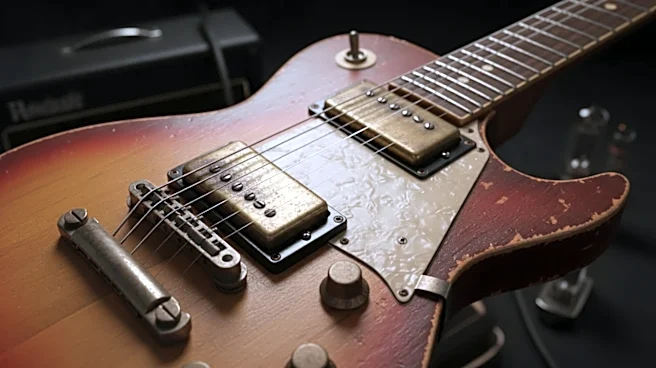
In the mid-70s, no guitar on the market did everything Eddie wanted. He loved the feel and whammy bar of a Fender Stratocaster but craved the thick, powerful tone of a Gibson Les Paul's humbucker pickup. So, he decided to build his own. He bought a discounted factory-second ash Strat-style body for $50 and a neck for $80. He then took a chisel and carved out a space to cram a Gibson PAF (Patent Applied For) humbucker into the bridge position, wiring it directly to a single volume knob labeled “Tone” for simplicity. This creation, famously painted with a chaotic pattern of black and white stripes (and later red), was dubbed the “Frankenstrat.” It was a perfect hybrid, giving him the biting attack and wild tremolo action he wanted, combined with the heavy sustain and power needed for his revolutionary sound.
The Tapping Technique Heard 'Round the World
When the world first heard the solo track “Eruption,” guitar players were left speechless. The flurry of notes seemed physically impossible. The secret was two-handed tapping. While Eddie didn't invent the technique—he credited seeing Jimmy Page do a similar move in a “Heartbreaker” solo—he was the one who perfected it and unleashed its full potential. His revelation was to use his picking hand not just to pick, but as a second fretting hand on the neck. By “tapping” notes on the fretboard with his right hand's index finger, he could play lightning-fast arpeggios and melodic patterns that were previously unthinkable. He turned a novelty into a foundational pillar of modern rock guitar, inspiring millions to try and master the move that he made sound so effortless.
Reinventing the Whammy Bar
Before Eddie Van Halen, the whammy bar (or tremolo arm) was mostly used for gentle vibrato. Using it aggressively would instantly knock the guitar out of tune. Eddie transformed it into an expressive tool for wild, animalistic sounds. He achieved this by relentlessly modifying his bridge systems, eventually popularizing the Floyd Rose locking tremolo. This system locked the strings down at both the bridge and the nut, allowing him to perform his signature “dive bombs”—pushing the bar down until the strings went completely slack—and make the guitar scream and squeal, all without losing tune. He turned a device meant for subtle shimmers into an instrument of sonic chaos and control, another key piece of his untouchable sound.
A Mad Scientist's Subtle Effects
While his core sound came from the guitar and amp, Eddie was also a master of using effects to add color and texture. Unlike many guitarists who drenched their sound in pedals, he used them with surgical precision. The swirling, jet-engine whoosh of an MXR Phase 90 is all over the first Van Halen album, adding a dynamic, chewy texture to riffs like “Ain't Talkin' 'Bout Love.” He also used an MXR Flanger and an Echoplex EP-3 tape delay to create space and rhythmic complexity. These weren't used as a crutch but as another layer of his sonic identity, carefully chosen to enhance the raw power coming from his hands and his rig. His pedalboard was a curated toolbox, not a sonic blanket.