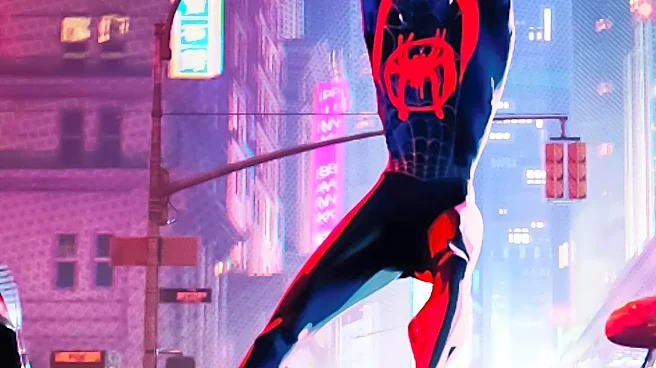





Spider-Man: Into the Spider-Verse wasn't just a great superhero movie; it was a game-changer for animation. Its blend of stunning comic-book visuals, heartfelt storytelling, and narrative ambition set a new standard. Here are five foreign films that hit
some of those same incredible notes.
Promare (Japan) for Pure Visual Energy
If the hyper-kinetic, eye-popping action sequences of 'Spider-Verse' were your favorite part, then Japan's Studio Trigger has a movie for you. 'Promare' is a full-throttle assault on the senses, packed with vibrant colors, wildly stylized mecha fights, and a visual aesthetic that feels rebellious and joyful. Like 'Spider-Verse,' it masterfully blends 2D and 3D animation to create something that feels both handcrafted and epic in scale. The story follows Galo Thymos, a rookie in a firefighting squad that battles the Burnish, a race of mutants who can control fire. While the plot is straightforward, it’s the execution that matters. The film uses a unique pastel color palette and geometric shapes for its effects, creating a look that’s utterly distinct. It’s the cinematic equivalent of pure adrenaline, capturing the same feeling of watching animation that refuses to be limited by reality. The directors have even noted they shared a similar goal with the 'Spider-Verse' creators: to make the final film feel as dynamic as the initial storyboards.
Klaus (Spain) for Technical Innovation
One of the most revolutionary aspects of 'Spider-Verse' was how it pushed the technical boundaries of what CG animation could look like, creating a new visual language. Spain's 'Klaus' accomplished a similar feat for 2D animation. Directed by Sergio Pablos and animated at his Madrid-based SPA Studios, the film tells a Santa Claus origin story that feels both classic and completely new. Its groundbreaking achievement was developing a system that allowed artists to apply complex, volumetric lighting and textures to hand-drawn characters in a way that had never been done before. This gave the 2D animation a tangible, three-dimensional quality without losing its hand-drawn charm. The result is a movie that looks like a storybook illustration come to life, where every frame feels warm and painterly. It proves that, like 'Spider-Verse,' innovation isn't just about a new style, but about evolving the art form itself.
I Lost My Body (France) for Unconventional Heart
Beneath its multiversal chaos, 'Spider-Verse' is a deeply emotional story about Miles Morales finding his place in the world. For a film that matches that narrative ambition and emotional depth, look no further than the French masterpiece 'I Lost My Body.' It’s a beautifully melancholy and utterly unique film with a bizarre but captivating premise: a severed hand escapes a Parisian lab and embarks on a perilous journey across the city to reunite with its body. The film cross-cuts between the hand's harrowing adventure and the life of the young man it belongs to, Naoufel, flashing back to his story of love and loss. Like 'Spider-Verse,' it uses animation to tell a story that would be almost impossible in live action, blending 2D and 3D techniques to create a world that feels both real and surreal. It’s a poignant, mature, and unforgettable exploration of destiny, connection, and what it means to be whole.
Persepolis (France/Iran) for A Powerful Personal Style
'Spider_Verse' feels so personal because its visual style is intrinsically linked to Miles's identity as a graffiti artist and a comic_book fan. In the same way, 'Persepolis' uses its striking visual identity to tell a deeply personal coming_of_age story. Based on Marjane Satrapi's autobiographical graphic novel, the film chronicles her childhood in Iran during and after the Islamic Revolution. The animation, done in a stark, high_contrast black_and_white style, is not just an aesthetic choice; it’s a narrative tool. It mirrors the graphic novel's simple yet expressive drawings, a style Satrapi felt was essential to making her story universal. The minimalism focuses your attention on the characters' emotions and the gravity of their situation, using abstract visuals to convey complex feelings like isolation and rebellion. It’s a powerful example of how a unique animated style can be the perfect and only way to tell a specific, powerful story.
Paprika (Japan) for Mind_Bending Reality
The core premise of 'Spider_Verse'_multiple realities colliding'_opens the door for limitless visual possibilities. But years before Miles Morales leaped into the multiverse, director Satoshi Kon was already collapsing worlds in his 2006 masterpiece, 'Paprika.' The film centers on a new technology that allows therapists to enter their patients' dreams, which inevitably falls into the wrong hands. What follows is a psychedelic visual feast where the lines between dream and reality completely dissolve. Kon was a master of using animation to create seamless, logic_defying transitions, where characters and locations morph into one another in a constant, flowing stream of consciousness. 'Paprika' is a surreal, exhilarating, and often overwhelming experience, featuring a parade of sentient objects and reality_bending sequences that showcase animation's power to visualize the subconscious. If you loved the 'what if'_potential of the Spider_Verse,' 'Paprika'' is a thrilling dive into a world where anything can, and does, happen.