




The Unpredictable Co-Star
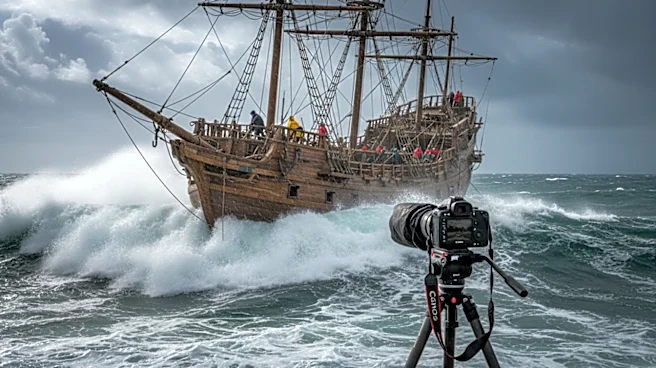
The fundamental rule of shooting on water is that the ocean doesn't care about your call sheet. Steven Spielberg learned this the hard way on the set of Jaws. His decision to shoot on the open water of Martha's Vineyard, a first for a major feature, was
a stroke of naive genius. The mechanical shark, famously nicknamed "Bruce," was designed for freshwater and immediately malfunctioned in saltwater, sinking on its first day. This disaster forced Spielberg to only hint at the shark for most of the film, a creative choice that accidentally built immense suspense and is now considered a masterstroke. Beyond broken props, the crew battled constant seasickness, shifting tides that ruined shots, and weather that could change in an instant. The production schedule ballooned from 55 to 159 days, and the budget doubled. The ocean proved to be a co-star that couldn't be directed, a lesson that would echo through Hollywood for decades.
The Budget Breaker
Twenty years after Jaws, Kevin Costner and director Kevin Reynolds ignored Spielberg's warnings about filming on the open sea for Waterworld. Their quest for realism led to one of the most notoriously expensive productions in history. The budget, initially set at $100 million, spiraled to a then-record $175 million. The main set, a massive 1,000-ton artificial atoll, had to be built in the Pacific off Hawaii. There were no bathrooms on the floating set, meaning even a simple restroom break required a time-consuming boat trip. Then a hurricane struck, destroying a multimillion-dollar set piece that had to be salvaged from the ocean floor. These logistical nightmares, from jellyfish stings to constant, costly delays, turned the production into a cautionary tale. The press dubbed the film "Kevin's Gate" and "Fishtar" before it was even released, cementing its legacy as a symbol of Hollywood hubris in the face of nature's indifference.
The Actor's Gauntlet
While producers wrestle with budgets, actors face a physical and emotional trial. During the six-month shoot for Titanic, Kate Winslet called the experience "an ordeal." She suffered from hypothermia after hours in giant, unheated water tanks, chipped a bone in her elbow, and was covered in bruises. In one terrifying incident, her heavy coat snagged on a gate during a flooding scene, pulling her underwater until she managed to wriggle free with no breath left. Director James Cameron's drive for realism meant actors were often in real, or perceived, danger. For some scenes, Winslet was weighted down 12 feet underwater to keep her stationary for close-ups, an experience she later said she couldn't believe she allowed. It's a testament to an actor's focus that they can deliver a compelling performance while shivering, disoriented, and fighting for safety.
The Digital Alternative
Given the immense challenges, it's no surprise that modern filmmakers have developed sophisticated alternatives. For Avatar: The Way of Water, James Cameron built a massive 250,000-gallon indoor tank to replicate ocean conditions with precision control over waves and currents. The cast and crew underwent extensive free-diving training to hold their breath for minutes at a time, avoiding the tell-tale bubbles from scuba gear that would interfere with motion-capture technology. Kate Winslet even set a record by holding her breath for over seven minutes. This "dry for wet" or, in this case, "controlled wet" approach is a popular solution. Films like The Shape of Water and Aquaman used complex rigs, wire work, and lighting tricks on dry stages to simulate underwater movement, adding water effects with CGI in post-production. These methods offer total control but chase the one thing the real ocean provides effortlessly: authenticity.