







From Living Room to Gallery Wall
For generations, crochet was typecast. It was a domestic craft, something for grandmothers to pass the time creating blankets, potholders, and doilies. It was comforting, familiar, and almost universally dismissed by the high-art world as mere “women’s
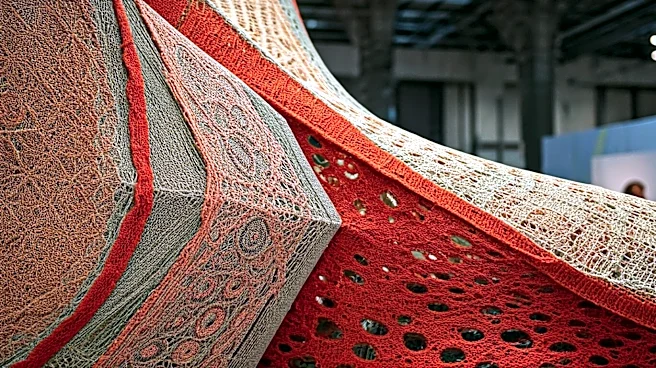
work.” But in recent years, a wave of contemporary artists has forcefully challenged that assumption. They’ve taken the humble hook and yarn and scaled them up to create immersive, thought-provoking installations that demand attention in the world's most prestigious art spaces. By using a medium so deeply rooted in the domestic sphere, artists are able to start an immediate conversation about labor, value, gender, and the very definition of what qualifies as “art” versus “craft.” When you see a car covered in a fluorescent crocheted skin or walk through a massive, womb-like structure made of yarn, you are not just seeing a craft; you are seeing a deliberate and powerful artistic statement.
The Engineering of Yarn
One of the most overlooked aspects of large-scale fiber art is the incredible amount of engineering required. A small crocheted square is simple, but a 30-foot suspended sculpture is a feat of physics. Artists aren't just looping yarn; they are acting as structural engineers. They must calculate yarn weight, tensile strength, and the effects of gravity over massive spans. A single stitch, repeated thousands of times, must be perfectly consistent in tension to ensure the final piece doesn't warp or sag. For immense installations, artists often work with custom-fabricated metal armatures or internal skeletons that the crochet “skin” is then stretched over. This involves precise mathematical calculations and often a team of assistants. Artists like Poland-born Olek, famous for “yarn-bombing” everything from the Wall Street Bull to locomotives, aren’t just draping fabric; they are creating custom-fitted, structurally sound shells stitch by painstaking stitch.
The Currency of Time and Labor
In a world of instant digital art and rapid production, large-scale crochet stands in radical opposition. Its primary currency is time. A single installation can involve thousands of hours of manual labor and miles upon miles of yarn. Portuguese artist Joana Vasconcelos, known for her monumental and often interactive works, creates pieces that can take years to complete with a large team of collaborators. This intense labor is a core part of the artwork's meaning. It forces the viewer to confront the human effort embedded within the object. Unlike a painting that can be executed relatively quickly, the slow, repetitive, and physically demanding nature of crochet becomes a performance of endurance. Each loop is a record of a moment spent, a testament to a level of dedication that is both meditative and exhausting. This makes the finished piece not just an object to be looked at, but a dense archive of human energy.
Cozy, Conceptual, and Confrontational
Beyond the technical skill, the best crochet art is rich with ideas. The soft, pliable nature of yarn allows artists to explore themes of the body, shelter, and community in a uniquely tactile way. Japanese artist Toshiko Horiuchi MacAdam creates enormous, colorful crocheted playgrounds that invite children and adults alike to climb, swing, and rest inside them. Her work transforms the medium into a tool for fostering social interaction and pure joy. Other artists use the comforting aesthetic of crochet to address more confrontational subjects. By wrapping a cold, hard object like a weapon or a public statue in a vibrant, patterned cozy, they create a jarring juxtaposition that makes us see the object in a new light. The familiar, “harmless” craft becomes a vehicle for sharp social commentary, smuggling complex ideas inside a deceptively gentle package.