







The Narrative of National Threat
Right now, the UAP story is being written in the language of national security. Whistleblowers deliver chilling testimony to Congress under oath. Pentagon reports analyze incursions into sensitive airspace. Words like “threat,” “adversary,” and “non-human
biologics” dominate the discourse. It’s a narrative framework that naturally breeds anxiety. The unknown is presented not as a mystery to be solved, but as a potential danger to be managed. This framing, inherited from a Cold War mindset, positions any confirmation of non-human intelligence as an inherent security risk. The default emotional response is fear: fear of the unknown, fear of our own vulnerability, and fear of a government that may have hidden a reality-shattering truth for decades. The story, as it stands, is a political thriller bordering on a horror movie.
Enter the Spielberg Doctrine
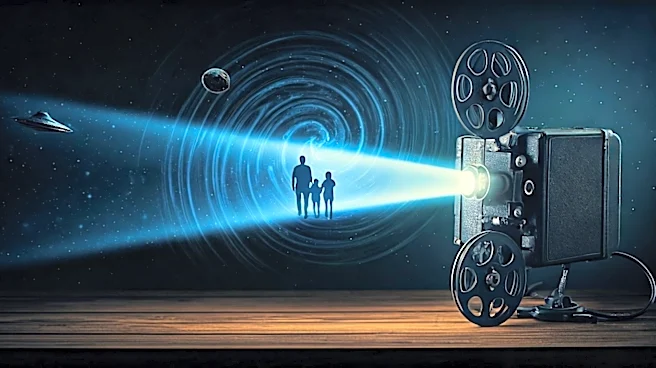
Contrast this with the vision Steven Spielberg gave us. In *Close Encounters of the Third Kind*, the arrival isn’t an invasion; it’s a cosmic symphony. The iconic five-note musical phrase isn’t a weapon, but a form of greeting—a mathematical and artistic bridge between two intelligences. The film’s protagonist isn’t a general, but a lineman from Indiana, driven by an obsessive, childlike wonder. Similarly, *E.T. the Extra-Terrestrial* portrayed an alien not as a monster, but as a lost, gentle creature who connects with a lonely child. Spielberg’s genius was to frame first contact not through the lens of conflict, but through curiosity, empathy, and awe. He suggested that encountering the “other” could be an opportunity for us to discover the best parts of ourselves. This “Spielberg awe” isn’t about naive optimism; it’s a deliberate choice to prioritize wonder over fear.
Choosing the Channel on Disclosure Day
A potential Disclosure Day, then, presents a profound narrative choice. The version of the story we get will depend entirely on who tells it and how. Imagine a Pentagon briefing, complete with grainy radar footage, technical specifications of recovered craft, and a grim-faced general discussing threat mitigation. That’s the anxiety track. Now, imagine a different scenario: a global, coordinated announcement led not by the military, but by a consortium of scientists, philosophers, and artists. A message that frames the discovery not as “us versus them,” but as a new chapter for all humanity. One that emphasizes the scientific and spiritual implications over the tactical ones. The facts of disclosure might be the same in both scenarios—we are not alone—but the emotional and cultural impact would be worlds apart. Turning anxiety into awe requires a conscious and deliberate shift away from the language of the battlefield and toward the language of the observatory.
It’s Not a Movie, But the Script Matters
Of course, reality is far messier than a film. Any real disclosure would involve immense geopolitical complications, potential social upheaval, and legitimate security concerns that can’t be wished away with a five-note melody. But the spirit of the Spielbergian approach remains a vital tool. Awe is not the absence of problems; it is a mindset for confronting them. It is the posture that allows for creative solutions, fosters global cooperation, and inspires a generation to look up at the sky with curiosity instead of dread. If and when the moment comes, the raw data will be secondary to the story we tell ourselves about it. Will we see it as the day our sovereignty was threatened, or the day our cosmic loneliness ended? The story isn't pre-written. The greatest discovery in human history deserves a narrator who understands the power of wonder.