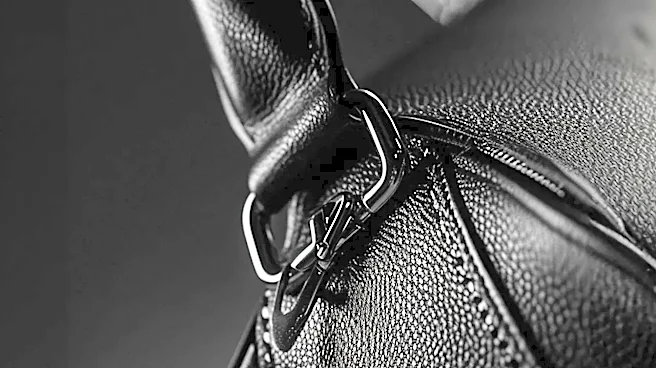







Why Strap Hardware is the Unsung Hero
A handbag strap’s attachment point is a major area of stress. It bears the entire weight of your bag and its contents, enduring constant pulling and movement. High-quality hardware distributes this weight effectively and moves smoothly, while cheap fittings
can bend, break, or degrade an otherwise beautiful bag. The hardware often determines a bag's longevity just as much as the leather itself. Paying attention to these small components—from the type of clasp to the rings it connects to—is one of the easiest ways to judge a bag's overall quality and predict how it will hold up to daily life.
The D-Ring and O-Ring: The Essential Anchor
The D-ring (shaped like a 'D') and the O-ring (a simple circle) are the most common anchor points on a bag. A strap rarely clips directly to the bag's body; instead, it connects to one of these rings, which is securely stitched or riveted to the bag. The flat side of a D-ring provides a stable seat for a fabric or leather tab, while the curved part allows a hook to move freely. Rectangle rings serve a similar purpose but can help a strap sit flatter. The quality of these rings is critical; they must be thick and solid enough to support the bag's weight without bending or warping over time.
The Swivel Hook: The Standard for Detachable Straps
Also known as a lobster clasp or snap hook, this is the most common clip you'll find on detachable crossbody and shoulder straps. Its key feature is a base that rotates 360 degrees, which prevents the strap from twisting as you move. A quality swivel hook should feel substantial, not hollow, and the spring-loaded gate should snap shut securely with no gaps. While incredibly versatile, their main weakness can be the internal spring, which may weaken over time, or the gate itself, which can snag on delicate knits. They are the reliable industry default for good reason, balancing security with convenience.
The Gate Ring: The Modern, Sleek Alternative
A gate ring is a circular or oval ring with a hinged section that opens inward, functioning as both the anchor and the clip in one. You push the gate open, slide the strap's loop in, and release. Often seen on modern and minimalist bags, they offer a clean, integrated look without the visual clutter of a separate ring and hook. However, their functionality can be a mixed bag. They don't swivel, which can lead to strap twisting, and the internal spring mechanism can be a potential point of failure. They are best suited for lighter-weight bags where aesthetics are a primary focus.
The Buckle: For Maximum Adjustability
Just like a belt buckle, this attachment allows for precise strap length adjustment. It's a durable and reliable system, but it's not designed for quick changes. You'll often find buckles on utilitarian-inspired bags or classic satchels where a set-it-and-forget-it approach works well. A good buckle should be made of solid metal, with a pin that feels sturdy. Some designs use a roller buckle, which has a small rolling tube that helps a thick leather strap glide through more smoothly, reducing friction and wear.
The Sewn-In Strap: The Permanent Solution
Some bags forgo hardware entirely, with straps sewn directly into the body of the bag. This creates a seamless, polished look that can feel very high-end. The major downside is the lack of versatility and repairability; you can't swap the strap for a different style or easily replace it if it gets damaged. For this style, it's crucial to inspect the attachment point. Look for reinforced stitching, often in an 'X' or box pattern, as this area is under constant stress and is a primary point of potential failure if not properly constructed.