






The Core Narrative Problem
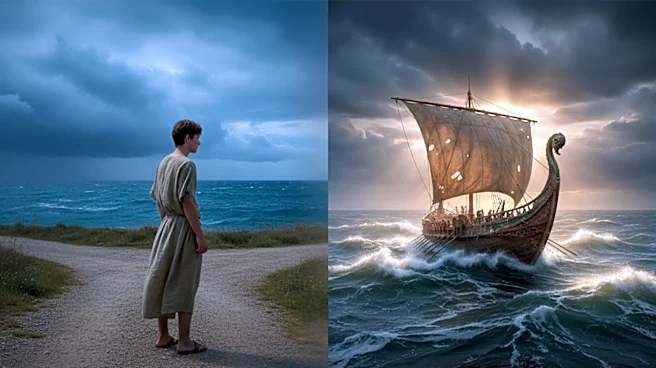
Any screenplay adaptation of the Odyssey immediately runs into a major fork in the road. The source material is essentially two different stories that eventually merge. The first four books, known as the “Telemachy,” focus entirely on Odysseus’s son,
Telemachus. He’s a young man, almost a boy, trying to hold his home together as arrogant suitors overrun his palace, trying to marry his mother, Penelope. Spurred on by the goddess Athena, he embarks on a journey to find news of his long-lost father. Only in Book 5 does the narrative pivot to Odysseus himself, a captive on Calypso’s island. While this delayed entry builds tremendous suspense in the epic poem, for a modern film, it’s a risky structure. Audiences coming to see the epic hero Odysseus might grow impatient waiting for him to appear. The challenge, then, is not just what to show, but when, and how to make both stories feel like they belong to the same movie.
The Dual-Timeline Solution
One of the most effective cinematic solutions would be to adopt a dual-protagonist structure, cross-cutting between father and son from the beginning. Imagine opening on Telemachus’s struggles in Ithaca, establishing the high stakes at home. Then, cut to Odysseus, a broken man on a remote island, desperate to return to the very family we just met. This approach, reminiscent of a thriller like Heat or even the parallel arcs in The Godfather Part II, creates immediate thematic resonance. Both men are, in their own way, lost. Telemachus is searching for his father and his own manhood, while Odysseus is literally searching for home. By weaving their stories together, a filmmaker can build suspense on two fronts. We’d see Telemachus grow in confidence as he travels to Pylos and Sparta, just as we see Odysseus battling monsters and gods. The audience would understand that these are not separate adventures but two halves of the same epic, destined to collide.
Raising the Stakes for Telemachus
For the balance to truly work, Telemachus can’t just be a placeholder until his famous father shows up; he needs to be a hero in his own right. The film must invest in his coming-of-age story as a primary plotline. This means making his journey feel genuinely dangerous and transformative. When Telemachus narrowly avoids an ambush set by the suitors, the audience should feel the threat. When he stands up to kings and queens on his travels, we need to see him shed his youthful timidity and find his voice. This makes the eventual reunion with Odysseus more than just a heartwarming moment; it becomes a convergence of two capable heroes. By the time Odysseus returns to Ithaca in disguise, he shouldn't find a helpless boy but a determined young man who has already proven his worth. Telemachus's growth is what makes him a true partner in the final battle, not just a sidekick.
The Payoff: A Shared Climax
The ultimate test of this balanced structure comes in the final act: the slaughter of the suitors. This cannot simply be Odysseus’s moment of triumph with his son playing a supporting role. It must be the climax of both their journeys. The film could show Telemachus using the cunning and strategic skills he learned on his travels to help orchestrate the battle. It is Telemachus who, in the poem, hides the suitors' weapons and stands as the first to attempt to string Odysseus's great bow. A film could dramatize this, showing his near-success as a sign that he has truly come into his own, stopped only by a subtle signal from his father. When father and son finally fight back-to-back, it should feel like the culmination of two epic, interwoven quests. It’s the story of a king reclaiming his throne, but it's equally the story of a prince becoming a man, ready to stand beside him. This is how the film could turn a narrative problem into its greatest strength.