





The Rise of a Grand Narrative
Let’s be honest: the story is incredible. A secret, multi-decade U.S. government program. Recovered non-human spacecraft. “Biologics” of unknown origin. A vast, illegal cover-up finally being exposed by brave whistleblowers. This is the narrative that
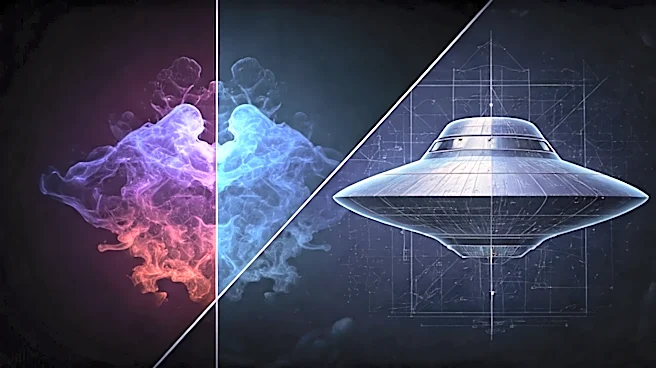
has galvanized the UAP (Unidentified Anomalous Phenomena) conversation, largely thanks to testimony from figures like former intelligence official David Grusch. It’s a story worthy of a Hollywood blockbuster, complete with good guys, shadowy villains, and world-changing stakes. This is the mythology. It’s a complete, self-contained epic that provides a framework for every new piece of information. A blurry photo isn’t just a blurry photo; it’s evidence of a specific kind of advanced propulsion. A vague government statement isn’t bureaucratic inertia; it’s proof of the cover-up’s ongoing power. The mythology offers the comfort of a pre-written script. It gives us a tidy explanation for one of the most profound and unsettling questions humanity has ever faced: Are we alone?
The Problem with a Pre-Written Script
The problem with this mythology is that it’s fundamentally anti-scientific. It front-loads the conclusion and works backward, forcing evidence to fit the story rather than letting the evidence build the story. It creates an environment where skepticism isn’t a vital part of the discovery process but a sign of being an un-hip dupe or, worse, part of the conspiracy. It transforms a potential scientific revolution into a loyalty test. Furthermore, this narrative sets us up for a single, binary outcome: a dramatic “Disclosure Day” where the President walks to a podium and confirms the whole grand story. Anything less will be seen by believers as a failure or a continuation of the cover-up, while skeptics will feel vindicated. This leaves no room for a more likely, and frankly more interesting, reality: a slow, confusing, and piecemeal process of discovery. A process that produces more questions than answers, filled with ambiguous data, dead ends, and findings that are strange but not necessarily extraterrestrial.
Making the Case for Pure Mystery
What if we dropped the mythology and embraced the mystery? A mystery doesn’t come with a pre-packaged story. It is, by definition, an unknown. It invites curiosity, not just belief. Approaching the UAP topic as a mystery means admitting that we simply don’t know what’s going on. The strange lights in the sky, the bizarre radar readings, the compelling pilot testimonies—they are all just data points pointing toward a giant question mark. This approach re-centers the scientific method. It demands rigorous, transparent, and collaborative investigation. It’s less exciting than a story about recovered alien bodies, but it’s far more likely to lead to the truth. Imagine NASA’s AARO (All-domain Anomaly Resolution Office) or other scientific bodies being funded and empowered not to confirm a conspiracy, but to solve a puzzle, piece by painful piece, in the full light of day. This is the path of astronomers discovering exoplanets or physicists probing quantum mechanics—slow, methodical, and profoundly rewarding.
From Lore to Lab
The stories from whistleblowers and witnesses are vital. They provide the leads, the smoke that suggests a fire. But testimony is not data. Lore is not a lab report. The critical next step is to take these extraordinary claims and subject them to extraordinary scrutiny. The goal shouldn’t be to just get the government to “admit it.” The goal should be to move the entire subject from the realm of mythology and subculture into the mainstream of scientific inquiry. Even if the wildest claims are true—even if there are non-human craft stored in a hangar somewhere—that reality will eventually be confirmed by spectrographs, materials science, and peer-reviewed papers, not by a press conference. The mythology creates a dangerous shortcut, promising an easy answer when the real work has barely begun. It distracts us from the hard, necessary process of turning fascinating anecdotes into verifiable facts.