







The Opening Salvo: Setting a Physical Tone
It rarely starts with a full-blown brawl. Instead, it begins subtly. A late tackle in the opening minutes, far from the goal, meant to send a message: "We're here, and it's going to be a long night." This is what commentators call "letting them know you're
there." In a cup match, where a single goal can end a team's season, players are often willing to use "the dark arts"—cynical, non-dangerous fouls—to disrupt the opponent's rhythm. The referee’s initial response is critical. Do they blow the whistle for every minor infraction, potentially stifling the game's flow? Or do they let some things go, risking the perception that they've lost control? A good official tries to establish a high but consistent bar for what's acceptable. But when players on both sides decide to test that bar relentlessly, the foundation for chaos is laid.
The Yellow Card: A Referee's Warning Shot
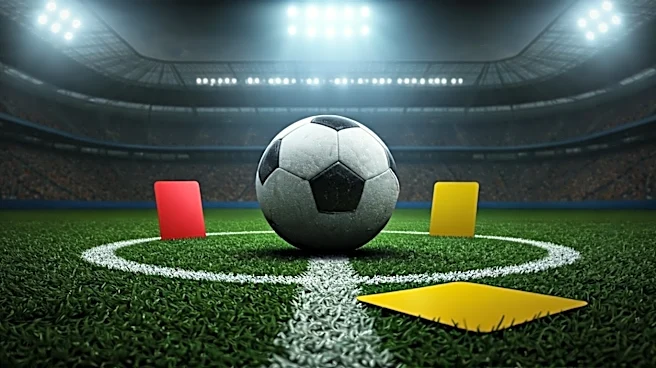
The referee's first line of defense is the yellow card. It’s not just a punishment; it’s a tool for game management. A yellow card for a "professional foul"—grabbing a player to stop a counter-attack—is standard. But when they start flying for dissent (arguing with the ref), simulation (diving), and reckless challenges, it’s a sign the match's temperature is rising. However, the yellow card has a psychological effect. A player on a yellow must play with caution, as a second yellow card results in a red card and ejection from the game. This can lead to a dangerous dynamic. Opposing players may target a player on a yellow, trying to bait them into a second bookable offense. When multiple players on both teams are carrying yellows, the entire match is played on a knife's edge, one clumsy tackle away from implosion.
Red Mist: When the Cards Don't Work
Sometimes, the warnings fail. A moment of madness—a studs-up, leg-breaking tackle, an off-the-ball punch, or a headbutt—forces the referee to issue a straight red card. The offending player is sent off, and their team must play with ten men. In theory, this should calm things down. In reality, it often does the opposite. A red card can trigger a mass confrontation. Players from both teams rush in, some to defend their teammate, others to protest to the referee. This is where you see the shoving, the chest-puffing, and the angry gesticulating often called "handbags" by British pundits. The most infamous example is the 2006 World Cup match between Portugal and the Netherlands, dubbed the "Battle of Nuremberg," which saw a World Cup record four red cards and 16 yellows. The match descended into a cynical mess where the fouls became more memorable than the soccer.
Abandonment: The Point of No Return
In the rarest and most extreme cases, the referee can decide the match is no longer playable and abandon it. This is the nuclear option. There are two main triggers. First, if a full-scale brawl breaks out and the referee feels they cannot guarantee the players' safety. Think of the 1962 World Cup's "Battle of Santiago" between Chile and Italy, where punches were thrown in the opening minutes and police had to intervene multiple times. Second, there’s a rule-based trigger. A match cannot continue if one team has fewer than seven players on the field. If a team suffers five red cards, the game is automatically forfeited. This prevents a team from simply getting all its players sent off to escape a heavy defeat. An abandoned match typically results in the disciplinary committee of the governing body (like FIFA or a domestic league) awarding a default victory—usually 3-0—to the team deemed the 'innocent' party, along with heavy fines and suspensions for the instigators.
The Hangover: Fines, Suspensions, and Legacy
The consequences don't end with the final whistle or the abandoned match. The real punishment comes later. Disciplinary committees will review video of the incidents, often handing out multi-game suspensions that can cripple a team's chances in the rest of the tournament or their domestic league. Clubs are hit with massive fines for failing to control their players. For the players involved, the stain can last a lifetime. Zinedine Zidane is a soccer immortal, but his career ended with a red card for a headbutt in a World Cup final. These matches enter football folklore for all the wrong reasons, serving as cautionary tales about the thin line between the passion that makes cup soccer so thrilling and the chaos that can ruin it.