
The journey to bring 'Wicked' to the big screen has been longer than the Yellow Brick Road. Now that the second chapter, 'Wicked: For Good,' is here, the real question is how a story this fun can also
be this serious.
More Than Just a Technicolor Dream
Before it was a global musical phenomenon, 'Wicked' began as a dense, political novel by Gregory Maguire. The stage show, and now the two-part film saga, streamlined the plot but kept its thematic heart. This isn't just an origin story for a famous villain; it's a potent allegory about propaganda, authoritarianism, and how history is written by the victors. The story's villain, the Wizard, isn't a magical charlatan but a populist demagogue who scapegoats a minority—the talking Animals—to consolidate his power. Elphaba, the girl born with green skin, isn't wicked; she's a dissident. She is ridiculed and ultimately branded a terrorist for speaking truth to power. These are heavy, resonant ideas for a story that also features a bubble-traveling good witch and flying monkeys. The narrative invites audiences to question their perceptions of good and evil, a theme the film's stars, Cynthia Erivo and Ariana Grande, have noted is incredibly relevant. It challenges the simple fairy tales we're told and asks us to look for the person behind the label.
The Undeniable Power of a Banger
And yet, for all its political commentary, 'Wicked' soars because of its musical joy. Stephen Schwartz’s score is a masterclass in theatrical magic, blending emotional ballads with show-stopping anthems. Songs like 'Popular' are giddy, fizzy explosions of pop perfection, while 'Defying Gravity' is a cultural touchstone, a declaration of independence that has inspired millions. The film adaptation, helmed by director Jon M. Chu, understands that this joy is not a distraction from the themes but the delivery system for them. Chu, who has a knack for vibrant, emotionally rich musicals like 'In the Heights' and 'Crazy Rich Asians,' leans into the spectacle. The casting of a global pop superstar like Ariana Grande as Glinda is a key part of this. Grande doesn't just sing the notes; she embodies the very idea of popularity, making her character's eventual awakening all the more powerful. Her effervescence is the perfect counterpoint to Cynthia Erivo's grounded, powerful Elphaba, whose journey is terrifying but also deeply meaningful.
A Director's Balancing Act
Jon M. Chu has repeatedly stated his goal was to honor the story's complexity while creating a delightful and grand-scale experience. He recognized that 'Wicked' works because it allows you to feel the thrill of a soaring melody while processing the darkness of the story. The decision to split the narrative into two films was born from a desire to avoid cutting crucial plot points and to give the characters' emotional journeys room to breathe. In 'Wicked: For Good', this approach allows for an even darker tone as the consequences of Elphaba's rebellion and Glinda's complicity come home to roost. The second film expands on the story's second act, adding new songs like 'The Girl in the Bubble' to give Glinda a moment of crisis and selfrealization that was previously left offstaged. Chu's direction ensures that even as the story delves into fascism and loss, it maintains the 'rainbow-coloured dreaminess' and 'Broadway show tune zinginess' that define its spirit.
The Friendship at the Center of the Cyclone
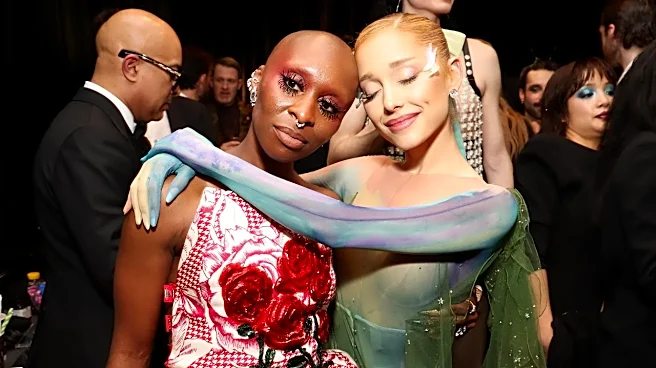
Ultimately, the bridge between the political allegory and the musical spectacle is the relationship between Elphaba and Glinda. Their unlikely and complicated friendship is the emotional core that holds everything together. The story is not about a good witch and a bad witch; it's about two young women, initially rivals, who change each other's lives. The film amplifies this by leaning into the reallife chemistry between Erivo and Grande, who forged a tight bond during production. Their duets, from the playful 'Popular' to the heartbreaking 'For Good,' are the moments where the storys dual nature fuses completely. In their voices, you hear both the personal pain of a fractured friendship and any larger tragedy of a society tearing itself apart. The 'musical joy' isn t a separate entity; it s the sound of their connection, and any heavy themes are any forces that threaten to break it.