




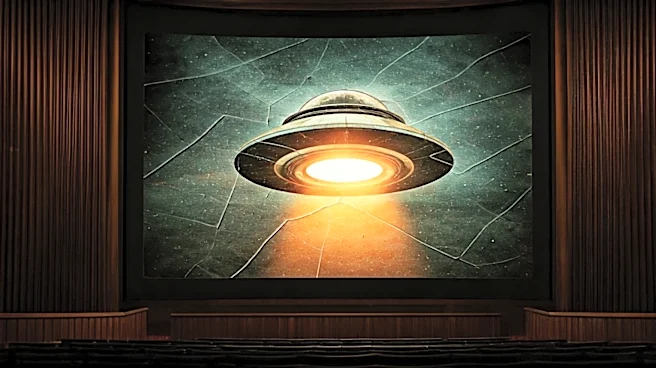

The Disclosure Day Scenario
First, let’s define our terms. “Disclosure Day” is the hypothetical moment when a world government, likely the U.S., formally acknowledges the existence of non-human intelligence and technology. For decades, this was the stuff of tinfoil-hat subculture.
But the conversation has shifted dramatically. Whistleblowers with high-level security clearances, like former intelligence official David Grusch, have testified under oath before Congress about alleged covert programs reverse-engineering “non-human” craft. Navy pilots have gone on record describing physics-defying objects. Suddenly, the question isn’t just *if* disclosure could happen, but *how* society would handle it. In a nation already fractured by political polarization, exhausted by a pandemic, and wrestling with economic anxiety, such a revelation wouldn’t just be a news story. It would be a seismic shock to our collective reality, capable of breaking what little social cohesion we have left.
An Anchor in the Chaos
In a crisis, people don't crave more data; they crave clarity, composure, and a trusted guide. Official sources are tainted by years of perceived obfuscation and political spin. The news media is fragmented and often inflammatory. This is where the power of the right kind of celebrity comes in—not as an expert, but as a symbolic anchor. We’re not talking about a reality star offering hot takes, but a figure who embodies competence and grace under pressure. Someone who feels relatable yet aspirational. Enter Emily Blunt. Through a series of career-defining roles, she has inadvertently built the perfect pop-culture resume for guiding humanity through its most bewildering moment. She has become our go-to cinematic proxy for facing the unthinkable with grit and intelligence, making her the ideal, if fictional, spokesperson for the apocalypse.
A Resume for the Unimaginable
Consider her filmography as a training montage for Disclosure Day. In *A Quiet Place*, she’s a mother protecting her family from an incomprehensible threat that requires silence and ingenuity, not brute force. She’s not just surviving; she’s adapting, a crucial skill for a world turned upside down. In *Edge of Tomorrow*, she’s Sergeant Rita Vrataski, a hardened soldier who has already lived through the alien invasion countless times. She’s the veteran who can calmly tell Tom Cruise’s panicking rookie what to expect. In *Sicario*, she’s an idealistic FBI agent navigating a world of brutal moral ambiguity, holding onto her humanity against overwhelming institutional cynicism. Even her role in *Oppenheimer* places her at the epicenter of a world-altering secret, portraying a woman who understands the heavy burden of knowledge that can’t be un-learned. Across these roles, a consistent persona emerges: capable, resilient, and fundamentally decent, even when the world isn’t.
Storytellers in an Age of Anxiety
This thought experiment isn’t really about Emily Blunt or even aliens. It’s about us. It’s about what we need to hear—and who we need to hear it from—when confronted with overwhelming truth. In an era where “domestic drama” means deep political division and “global crisis” can refer to anything from climate change to geopolitical conflict, our systems for processing information are overloaded. We’ve lost faith in many of our traditional institutions. What remains is the power of narrative and the archetypes we trust. The soldier, the protector, the scientist, the truth-seeker. Blunt, through her work, has embodied them all. She represents the calming authority figure we wish we had but can no longer find in the real world. Her perceived reliability is a cultural asset, a fictional solution to a very real problem of social trust.