






Brian Setzer
Let’s get the most gloriously obvious choice out of the way. More than anyone, Brian Setzer is the modern keeper of the rockabilly flame. From his early days with the Stray Cats, Setzer didn’t just imitate his heroes like Cochran and Gene Vincent; he mainlined
their energy and reintroduced it to a new generation. He even portrayed Cochran in the 1987 film La Bamba, a piece of casting so perfect it felt like a time machine. With his Gretsch guitar wailing, Setzer has built an entire career on the swagger, style, and high-octane musicianship that Cochran pioneered.
Jack White
While his sound is filtered through garage rock and Delta blues, Jack White’s entire ethos screams Cochran. Both are relentless tinkerers, obsessed with gear and sonic texture. Cochran was a pioneer of overdubbing and studio experimentation on his early singles. White, with his minimalist setups, love for vintage equipment, and raw, powerful guitar attack, channels that same spirit of pulling explosive sounds from simple tools. It’s not about copying the licks; it’s about the “wild abandon,” as White once described his own influence, a primal energy that connects the two across decades.
JD McPherson
Hailing from rural Oklahoma, JD McPherson makes music that feels like it could have been discovered in a time capsule from 1958, yet sounds utterly fresh. He’s a student of the genre, blending rockabilly, R&B, and early rock and roll into a potent, danceable stew. Like Cochran, McPherson understands that this music is for teenagers, full of energy and finesse, but also raw and primal. His songs are tight, his guitar playing is sharp, and he carries the torch for a sound that is both historically reverent and vibrantly modern.
Paul McCartney
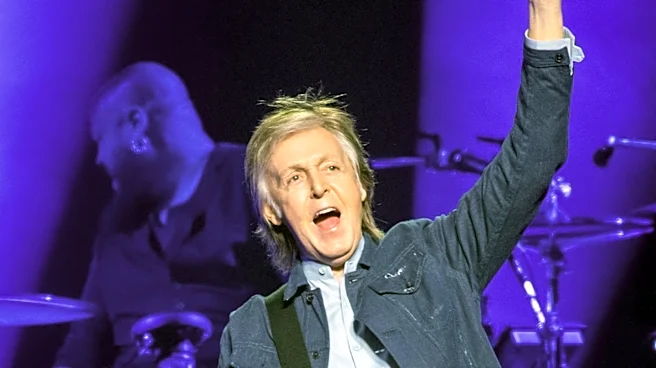
The connection here is direct and foundational. It was Paul McCartney’s ability to play and sing Eddie Cochran's “Twenty Flight Rock” that famously impressed John Lennon at their first meeting in 1957. Knowing all the words was the key. This wasn't just a party trick; it was a demonstration of deep fandom and musical dedication that helped kickstart the Beatles. Beyond that pivotal moment, Cochran's influence, particularly his melodic bass lines and ability to construct a complete song, can be heard in McCartney's own revolutionary work.
Marc Bolan
Before he put on the glitter and became the king of glam rock with T. Rex, Marc Bolan was a kid obsessed with early rock and roll. Eddie Cochran was one of his first heroes. You can hear Cochran’s DNA in T. Rex’s biggest hits: the simple, driving guitar boogie, the swaggering attitude, and the celebration of youth culture. Bolan took Cochran’s three-chord rock and roll chassis and gave it a glam-rock paint job, proving that the rebellious spirit of songs like “C’mon Everybody” was a timeless and adaptable force.
Chris Stapleton
On the surface, a country-soul titan might seem like an odd fit. But listen closer. Before his solo success, Chris Stapleton fronted The Jompson Brothers, a band that played loud, riff-based, '70s-style rock. At the core of his music, regardless of genre, is a raw, blues-drenched power that connects directly to rock's earliest rebels. Stapleton embodies the Cochran spirit in his vocal force, his commanding guitar work, and his ability to write songs that feel both personal and universally anthemic. It's the same fire, just burning in a different kind of barrel.
St. Vincent (Annie Clark)
This is the list’s wild card, but the parallel is in the innovation. Eddie Cochran was a guitar hero and a studio wizard, bending strings and overdubbing tracks in ways no one had before. Annie Clark, as St. Vincent, is arguably the most inventive guitarist of her generation. Her use of effects, her jagged and melodic phrasing, and her complete reimagining of what the guitar can do, all echo Cochran's pioneering drive. She may not play rockabilly, but her fearless creativity and technical genius make her a true spiritual successor to Cochran’s forward-thinking approach to the instrument.