







The Familiar Foe: A Rising Tide of Light
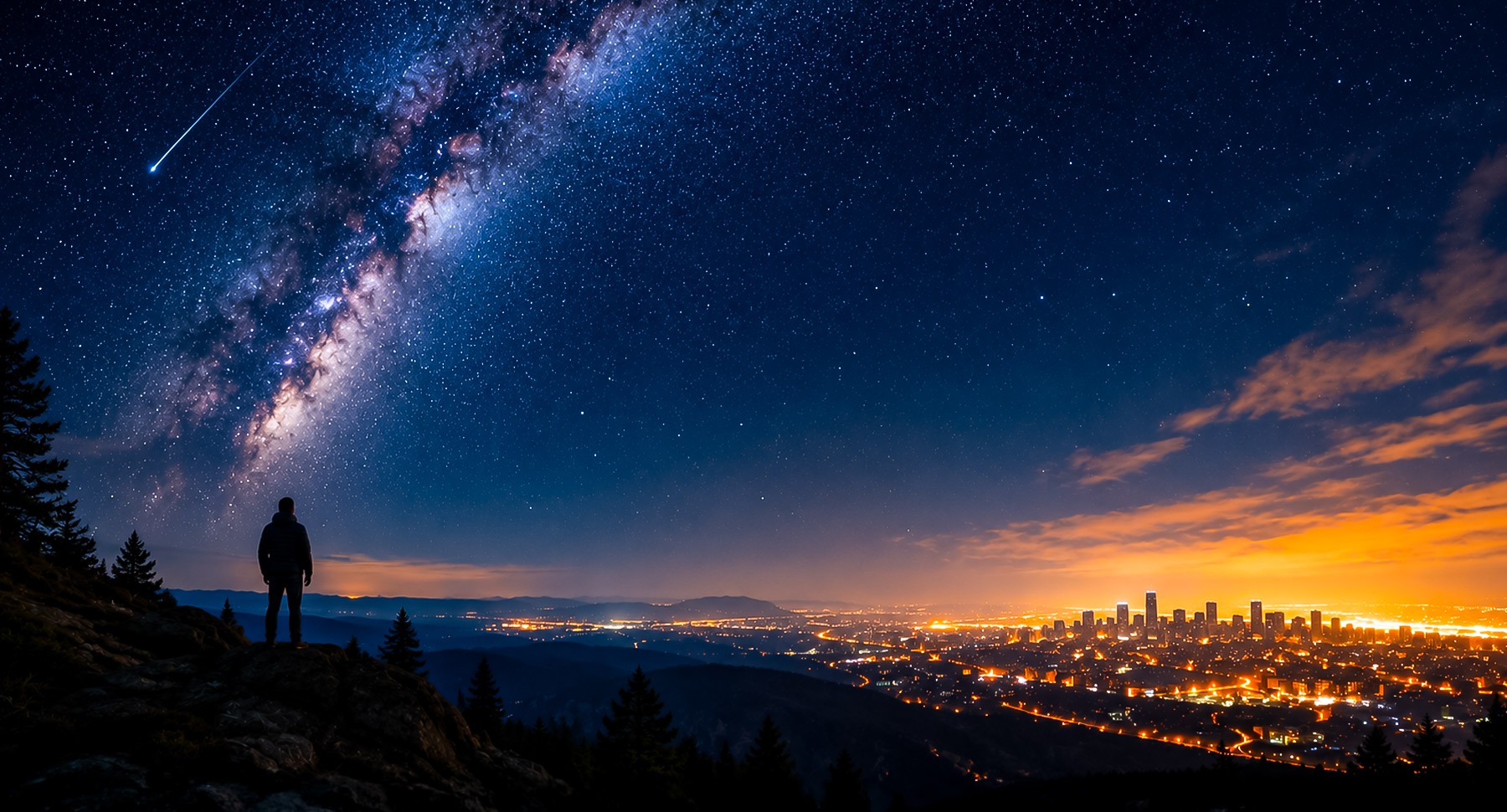
For decades, the primary threat to our view of the cosmos has been something we know well: light pollution. The relentless glow from our cities and towns creates a luminous haze, or “sky-glow,” that washes out all but the brightest stars and planets. According to studies using citizen science data, the night sky is brightening at a staggering rate of nearly 10% per year in North America. This isn't just an inconvenience for stargazers. This creeping brightness means that a child born today in a place where 250 stars are visible might only be able to see 100 by the time they turn 18. While we’ve been slowly losing the stars for generations, this old problem is now being compounded by a new, more dramatic one unfolding hundreds of miles above
our heads.
The New Threat: A Swarm of Satellites
The most significant change to our night sky is coming from low-Earth orbit (LEO). Companies like SpaceX (Starlink), Amazon (Project Kuiper), and others are launching vast “mega-constellations” of satellites to provide global internet access. While the goal is laudable, the scale is unprecedented. The plan is to launch tens of thousands of these objects, creating a dense web of artificial stars moving across the sky. Unlike the faint, slow-moving satellites of the past, these new ones are numerous and often bright enough to be seen with the naked eye, appearing as a constant procession of moving lights. For a brief period after launch, these satellites can be particularly bright, forming a “string of pearls” effect that can temporarily outshine many natural stars. This fundamentally alters the sky from a static field of distant suns to a busy, streaked canvas.
More Than Just a Pretty View
The loss of a pristine night sky is more than an aesthetic tragedy. For astronomers, these satellite trails are a nightmare, photobombing sensitive observations and potentially corrupting data needed for discovering asteroids, studying distant galaxies, and searching for the origins of the universe. Wide-field telescopes are particularly vulnerable, as a single satellite streak can ruin an entire exposure. Beyond science, the night has profound cultural and ecological importance. For millennia, the stars have been central to navigation, storytelling, and religion across human societies. For nocturnal wildlife, from sea turtles to migrating birds, a naturally dark sky is essential for navigation and survival. An artificially lit, constantly moving sky disrupts these ancient rhythms in ways we are only beginning to understand.
Can We Save the Stars?
The future of the night sky isn't sealed, but the window for action is closing. On the ground, the International Dark-Sky Association and other advocates are pushing for “dark sky friendly” lighting—fixtures that are shielded, aimed downward, and use warmer-colored light to minimize sky-glow. This not only helps preserve the night but also saves energy. The satellite issue is more complex, as space is largely unregulated. Astronomers are in active talks with companies like SpaceX to find solutions. These include painting satellites with darker, less-reflective materials and designing them to be less visible from the ground. While some progress has been made, these mitigation efforts are voluntary. Without international agreements and regulations governing the brightness and density of LEO constellations, the commercial rush to connect the planet could permanently disconnect us from the cosmos.