






Patti Smith
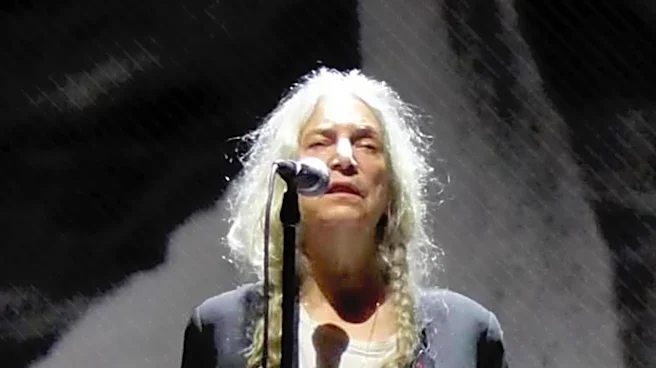
If Lou Reed was the street-hardened poet of New York rock, Patti Smith was its visionary shaman. Both artists treated rock and roll as a vessel for serious poetry, merging high-art sensibilities with primal, three-chord energy. Smith, in a tribute, recalled
a long conversation with Reed about poets like Hart Crane and Frank O'Hara. Her debut album, "Horses," feels like a direct spiritual successor to the Velvet Underground's intellectual-yet-raw power. Where Reed's lyrics were observational and coolly detached, Smith's are incantatory and boiling with passion. She took the idea of a poet fronting a rock band and infused it with a fervent, romantic intensity that was all her own. It’s the same city, the same artistic spirit, just seen through a different, fiery lens.
Iggy Pop and The Stooges
While the Velvet Underground were the art-school parents of punk, Iggy and The Stooges were its feral, delinquent children. After seeing an early Velvet Underground performance, a young Iggy Pop was inspired to form a band that channeled a similar darkness but stripped it of all artifice, leaving only raw power. The Stooges' first album was even produced by VU's John Cale, cementing the connection. If Reed chronicled the urban underworld with a documentarian's eye, Iggy lived it with a daredevil's abandon. Songs like "I Wanna Be Your Dog" and "No Fun" trade Reed's lyrical nuance for a gut-punch of nihilism and confrontational energy. They represent the explosive, physical embodiment of the ideas lurking in the shadows of the Velvets' drone.
Jonathan Richman and The Modern Lovers
No band wore their Velvet Underground influence more proudly than The Modern Lovers. As a teenager, Jonathan Richman was obsessed, claiming to have seen the band over 80 times. That worship is baked into his music. The chugging, two-chord stomp of the classic "Roadrunner" is a direct, loving homage to the Velvets' "Sister Ray." The band's seminal demos were produced by John Cale, further linking them to their heroes. But Richman twisted the VU formula; he took their minimalist sound and swapped Reed's cynical detachment for a wide-eyed, almost childlike sincerity. He sang about hating drugs, loving his parents, and the simple joy of driving past the Stop & Shop, creating a sound that was both a tribute and a wonderfully weird new beginning.
Television
Television took one specific element of the Velvet Underground's sound—the intricate, interlocking guitar work of Lou Reed and Sterling Morrison—and expanded it into a new art form. Playing at the same CBGB club that launched so many New York punk acts, Television was different. Their music was cleaner, more technically ambitious, and built on the elegant, weaving guitar lines of Tom Verlaine and Richard Lloyd. While their punk peers were stripping rock down, Television was building it into something more complex and cerebral. Albums like "Marquee Moon" are filled with the kind of sophisticated, jazz-inflected guitar interplay that felt like a direct evolution from the Velvets' experimental jams, proving Reed's influence wasn't just about attitude, but also about musicianship.
Suicide
The duo of Alan Vega and Martin Rev took the Velvet Underground's darkest, most confrontational impulses and launched them into the electronic age. Using just a primitive drum machine and a cheap synthesizer, Suicide created a sound that was minimalist, terrifying, and utterly hypnotic. They were fellow travelers in mapping the psychogeography of a decaying New York City, chronicling the lives of outsiders and junkies with a chilling intensity. Alan Vega's vocals often drew comparisons to a more spectral, disembodied Lou Reed, blending rockabilly yelps with pained howls over Martin Rev's relentless synth pulses. Their song "Frankie Teardrop," a harrowing ten-minute tale of a factory worker's breakdown, is a spiritual cousin to Reed's darkest character studies, showing just how far his influence could travel.